
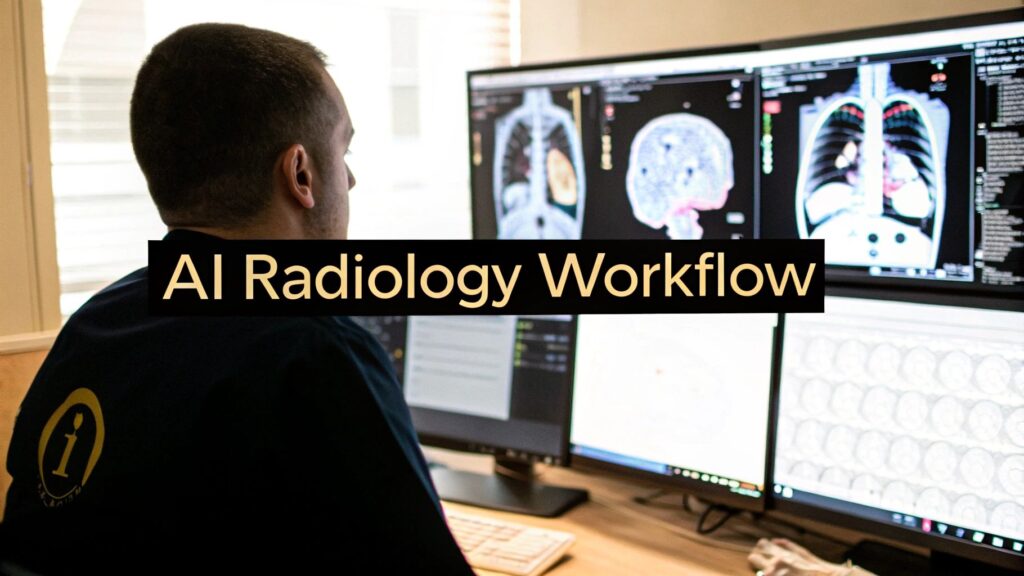
Radiology workflow optimization is how an imaging service runs the worklist: interruptions, the chain from order to report, image routing, PACS/RIS, and communication windows so a radiologist can keep focus time. It is not “what is AI in radiology,” and it is not generic scheduling/billing automation.
If you meant what AI in radiology is → artificial intelligence in radiology. If you meant general workflow automation → healthcare workflow automation. If you meant imaging-department ops (scanners, TAT, utilisation) → how to improve operational efficiency in medical imaging. If you meant PACS/RIS systems → radiology information systems and PACS.
This page already owns /blog/radiology-workflow/. PYCAD is not a radiology-workflow product page.
4.2 messages an hour
Volume and staffing are the obvious squeeze. The quieter killer is interruption. One academic practice logged more than 39,000 electronic messages on CT requests and measured 4.2 messages per hour — over 100 a day — hitting the people trying to read. That is not a “communication culture” problem. It is a broken window into the worklist.
Bottlenecks on the imaging chain
- Scheduling / registration that leaves a slot empty or a history blank
- Acquisition delayed by protocol chaos or a dead room
- Interpretation backlog (the unread pile)
- Report generation and distribution that still needs a fax personality
- Referring-physician ping-pong for missing context
Fix the step you measured. A market-size slide ($X billion AI-radiology CAGR) is not a bottleneck.
Routing, PACS/RIS, AI as a workflow tool
Intelligent routing sends the study to the right subspecialist and urgency without a human sort. Predictive “where will we clog at 3 p.m.” is useful if it changes staffing that afternoon. Diagnostic support (CAD, a first-pass flag) is a worklist tool here — not a what-is-AI explainer.
| Move | Job | Horizon |
|---|---|---|
| Smart routing | Modality / body part / urgency → the right queue | Months, if the RIS already has the fields |
| Cloud image access | Read off-site without a VPN dance; disaster copy | Months |
| PACS/RIS integration | No re-key between order, image, and report | The 40% “fewer manual steps” claim is an implementation, not a product category |
| Worklist AI (triage / CAD) | Critical studies first; a second pass on the pixels | Only after the worklist is trusted |
These sit on the PACS/RIS you already run. A sidecar that cannot write the report back is a demo.
Communication windows
Protect focus time. Batch routine messages into named windows. Flag true stat (stroke, PE, OR waiting) on a separate path with a named escalation — who is on, what “stat” means, how long until it is allowed to break a read. Secure messaging to the referrer beats a page-and-hold. Task software is optional; the rule is not.
| KPI | What good looks like | Cadence |
|---|---|---|
| Report TAT | Exam complete → final report. Aim under a day for routine; stat is minutes-to-hours | Daily |
| Exams per radiologist | Throughput without making discrepancy the hidden cost | Daily / weekly |
| Error / discrepancy rate | Keep it low; do not buy TAT with misses | Monthly |
| Patient wait (exam) | Slot discipline, not a lobby problem only | Daily |
| Turnover / no-show | Whether the schedule is honest | Weekly |
PYCAD deploys imaging AI into real DICOM workflows (viewers, annotation, models on studies that already move through PACS). That is a connector / imaging stack, not a radiology-workflow product, and this URL is not a services page. Case studies.