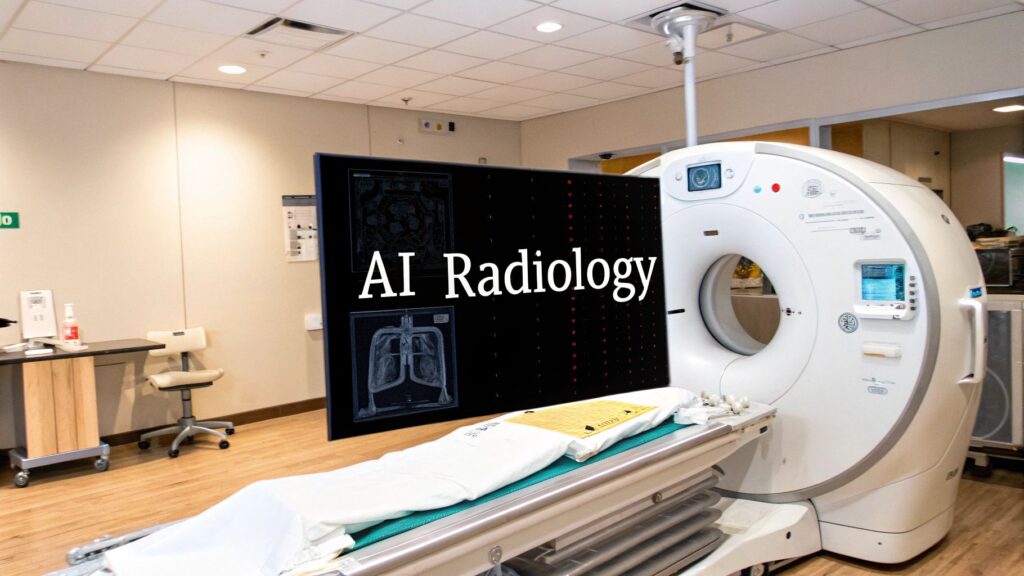
Artificial intelligence in radiology is software that reads imaging studies — X-ray, CT, MRI, mammography, ultrasound — and returns a mark, a score, or a short draft a radiologist then uses or ignores. It is not a robot radiologist. It does not sign the report.
The same job gets sold under different nouns: AI radiology software, benefits of AI in radiology, “will AI replace radiologists.” Those are keyword wraps of this page. Diagnosis as a specialty topic is a different article. So is AI in healthcare (the broad stack). Two paper notes sit next to this explainer: Merlin (CT-native foundation models) and RADAR (3D report review).
What it actually does
Most of what ships is a second reader. After the exam, images go into a model. The model flags candidates. The radiologist reviews the flags with the originals and signs. That workflow has been called computer-aided diagnosis for decades. The generic diagnosis page is AI for medical diagnosis — a different job from this one.
- Detection. Nodules on chest CT, intracranial hemorrhage on non-contrast head CT, pulmonary embolus on CTA, fractures on X-ray, masses on mammography.
- Triage. Bump the worklist when a critical flag fires so the urgent study is read first.
- Quantification. Organ or lesion volumes, ejection fraction, nodule doubling time. The number is a measurement, not a diagnosis.
- Draft text. Some systems propose a findings paragraph. Checking that draft against the 3D study is a separate job — see RADAR.
| Modality | Typical job | Who signs |
|---|---|---|
| X-ray | Fracture, pneumothorax, nodule candidates | Radiologist |
| CT | Bleed, PE, organ / lesion volume, worklist bump | Radiologist |
| MRI | Lesion characterization, brain / MSK measurements | Radiologist |
| Mammography | Mass / calcification candidates (CAD-style) | Radiologist |
CT-native foundation models — weights trained on volumes plus reports, not a 2D net stretched to 3D — are the research layer under some of this. That is the Merlin note, not a product you buy off a slide.
Will AI replace radiologists?
In 2016 Geoffrey Hinton said training radiologists was a waste because deep learning would take over within five years. The five years passed. Residencies did not close. Imaging volume went up; so did the need for people who sign reports.
Two reasons the prediction missed:
- The models are narrow. A lung-nodule net does not read a trauma pan-scan, does not take a call from the surgeon, and does not own the signed report.
- Volume grew faster than headcount. More scanners, more screening, more incidental findings. A tool that flags a thousand candidates still needs a reader who can drop the false ones and keep the real ones.
Most cleared imaging AI is assistive (FDA SaMD), not autonomous. A mark is a candidate. The radiologist still signs. Workforce shortage is a different article — shortage of radiologists — not this one.
How a department actually buys it
The “AI radiology software” posts that used to live on this site were this explainer with a vendor noun. The real sequence is shorter.
- Name one problem. “Flag intracranial hemorrhage on non-contrast head CT and bump the worklist.” Not “bring AI to radiology.”
- Ask what is cleared. FDA or CE, on which scanners, for which indication. Then re-validate on your machines. A paper AUC is not a site number.
- Land the flags in the viewer the radiologist already uses. PACS / RIS / a web DICOM viewer. A separate portal is how tools die.
- Keep a person on the output. Worklist, viewer, signed report. Build vs fine-tune vs buy is a cost decision, not a different product.
| Path | When | You own |
|---|---|---|
| Build | No product exists; unique data or workflow | Weights, pipeline, liability |
| Fine-tune | Standard imaging task, you have labeled studies | The adapted net; not the pre-train |
| Buy (cleared SaMD) | Commodity task; speed matters more than custom | A contract and a validation set |
What it does not do
- It does not replace the reader. The signed report is still a person. That is why most imaging AI is cleared as assistive, not autonomous.
- It fails on shift. A model trained on one vendor, protocol, or hospital will miss or over-call on another. You re-validate on your scanners.
- It inherits the labels. Narrow demographics, one site, or noisy reports become biased flags. That is a dataset problem, not a “fairness module.”
- It is not a market forecast. Vendor CAGRs and “$X billion by 2032” are not a reason to buy, and they are not this page.
If the question is diagnosis / CAD as a specialty, that is AI for medical diagnosis. If the question is the broader healthcare stack, that is what is artificial intelligence in healthcare. CT-native weights and a 3D report-review benchmark are the Merlin and RADAR notes.
PYCAD builds the imaging side of this — custom pipelines and web DICOM viewers when the study has to live in a clinic app. Case studies.