
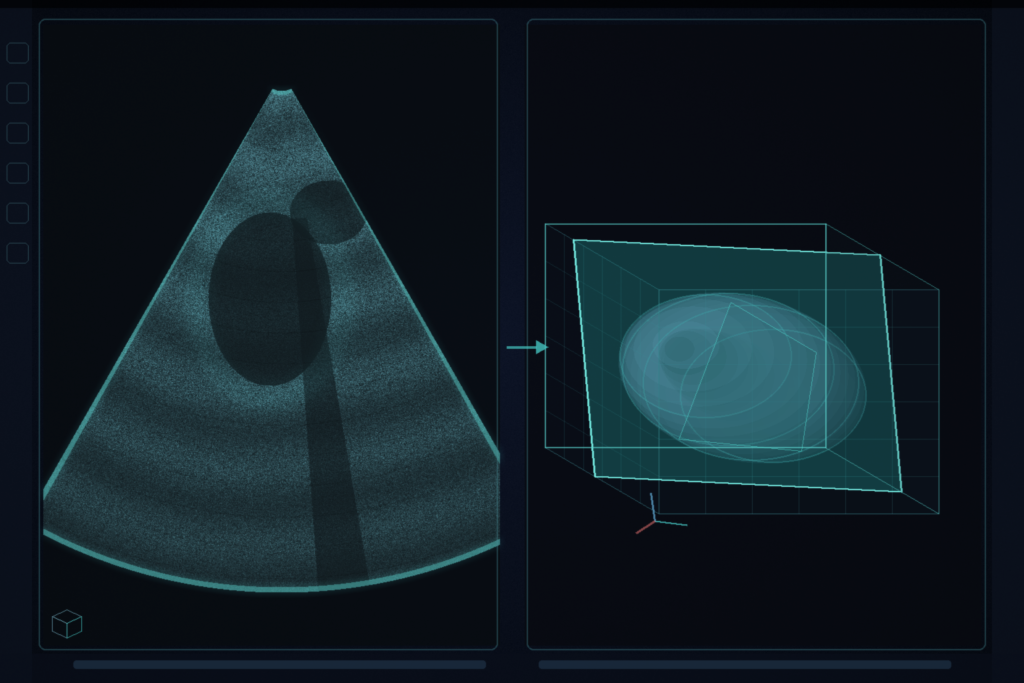
Hang a live 2D ultrasound next to a 3D US volume and you want the current frame sitting on that volume lattice, without an optical or EM tracker on the probe. SCoPE-Reg takes the untracked slice plus the volume and returns a rigid six-DoF pose. Niklas Schwarz, Jens Kleesiek, and Moritz Rempe (Institute for AI in Medicine (IKIM), University Hospital Essen, with Cancer Research Center Cologne Essen (CCCE), RACOON Study Group Site Essen, Department of Physics at TU Dortmund, German Cancer Consortium (DKTK) Partner Site Essen, Medical Faculty and Faculty of Computer Science at the University of Duisburg-Essen, and Department of Radiology, Brigham and Women’s Hospital, Harvard Medical School) posted arXiv:2608.28715 on 28 August 2026. The paper is SCoPE-Reg: Efficient Rigid Ultrasound Slice-to-Volume Registration via State-Space Correlation and Closed-Form Pose Estimation. The authors say supplementary code is provided and will be open-sourced upon acceptance. No public GitHub URL appears in the preprint. Likely SCoPE-Reg repository paths returned 404 when checked on 1 September 2026.
The hang they have in mind is intra-procedural: cardiac frame-to-volume fusion, targeted prostate biopsy, hepatic ablation, and intraoperative margin assessment. Hardware tracking still exists. This is image-based slice-to-volume registration when you do not want extra kit.
State-space correspondences, then closed-form Kabsch
Independent ResNet-8 encoders run on the 2D frame and the 3D volume. A Correlation-Weighted Coordinate Decoder (CWCD) uses State-Space Slice-Volume Fusion (SSVF): Mamba-style selective scans in four in-plane directions, linear complexity. That scan predicts a dense 3D coordinate field q and per-location evidence weights w. Each predicted coordinate is a convex combination of the encoded volume grid, so it stays inside that hull. A Weighted Kabsch Pose Solver (WKPS) recovers rotation and translation in closed form. The solver is parameter-free and differentiable. Training uses pose loss only, on 14 reference points (corners and face centers of a cube). There is no direct supervision on q or w.
The network has 6.49 M parameters, independent of resolution. On CAMUS at 5122 they report 51 FPS and 678 MiB. At 1282 it is 150 FPS and 79 MiB. CU-Reg reaches 32.6 GiB at 5122.
CAMUS cine stacks and transrectal prostate volumes
CAMUS (Leclerc et al., 2019) is 1000 apical 2CH and 4CH echo studies from 500 patients. The third axis is temporal, an end-diastole to end-systole cine stack, not spatial depth. The 5-fold split is 350 / 50 / 100 patients. SCoPE-Reg mean target registration error is 0.73±0.04 mm versus 1.24±0.15 mm for EUReg. Every evaluated CAMUS frame falls within 3 mm (100.0%) versus 97.2% for EUReg. Peak error is 5.49 mm versus 12.47 mm. The 95th percentile is 1.37 mm versus 2.01 mm. The identity baseline sits near 8.17 mm.
μ-RegPro (Baum et al., 2023, MICCAI challenge dataset) is 146 volumes from 73 transrectal prostate cases, cropped 40×64×64 at native 0.8 mm isotropic, TRUS-to-TRUS. SCoPE-Reg mTRE is 2.27±0.08 mm versus 2.63±0.23 mm for EUReg. 80.4% of frames fall within 3 mm versus 66.2%. Peak error is 5.95 mm versus 6.77 mm. Identity sits near 8.44 mm. EUReg keeps a slightly lower translation error (1.34 mm versus 1.42 mm). SCoPE-Reg has the lower rotation error (5.44° versus 7.01°). About one fifth of μ-RegPro frames still exceed 3 mm. The authors suggest aggregating the evidence weights w as a fail-closed confidence.
On CAMUS at 1282, SSVF with direct pose heads reports mean mTRE 0.68 mm and a 10.04 mm peak. CWCD plus WKPS sits at 0.73 mm mean and a 5.49 mm peak. The closed-form solver is there for the tails. Under larger simulated pose offsets, still on CAMUS 1282, perturbation magnitude 10 keeps 0.73 mm; magnitude 25 rises to 3.67±0.14 mm. EUReg at magnitude 25 is 5.54±1.10 mm.
Those numbers come from simulated 6-DoF perturbations, not tracked probe motion. The authors say sequence-level tracked-sweep validation is next. The method is rigid only. CAMUS’s third axis is cardiac phase, not a true 3D volume.
How this lands in a viewer
If you already hang live 2D US next to a 3D US volume in a DICOM viewer, treat this as a pose rail. Load the volume, ingest the current untracked frame, hang the six-DoF cutting plane on the lattice. Fail closed when the anatomy is deforming so a rigid pose is the wrong model, when about one fifth of TRUS frames would miss a 3 mm bar, or when weights are not yet public. Do not treat millimetre mTRE on public folds as a device claim.
ZODIAC takes a partial intraoperative US bone surface and returns a lumbar mesh. That is a different problem. SLIP is interactive 3D segmentation with latency and undo. Cine aorta contours keep overlays through systole. This paper is untracked 2D US frame plus 3D volume in, rigid six-DoF pose out.
Rebuild from arXiv:2608.28715 when code lands. As of 1 September 2026 there is no public GitHub URL. The preprint is the source of record until a camera-ready version exists.
Sources
- Schwarz, N., Kleesiek, J., Rempe, M. SCoPE-Reg: Efficient Rigid Ultrasound Slice-to-Volume Registration via State-Space Correlation and Closed-Form Pose Estimation. arXiv:2608.28715, posted 28 August 2026. https://arxiv.org/abs/2608.28715. Authors state supplementary code will be open-sourced upon acceptance. No public GitHub URL in the preprint (checked 1 September 2026).
- Leclerc, S., et al. Deep Learning for Segmentation Using an Open Large-Scale Dataset in 2D Echocardiography. IEEE Trans. Med. Imaging 2019. DOI: 10.1109/TMI.2019.2900516
- Baum, Z.M.C., Saeed, S.U., Bonmati, E., Barratt, D.C., Hu, Y. μ-RegPro: MICCAI 2023 Challenge on Prostate MR to Ultrasound Registration, Dataset. Zenodo, 2023. DOI: 10.5281/zenodo.7870104. Challenge site: https://muregpro.github.io/
- Wang, H., Wang, Y. EUReg: End-to-End Framework for Efficient 2D-3D Ultrasound Registration. MICCAI 2025. DOI: 10.1007/978-3-032-04937-7_17
- Guo, H., Xu, X., Xu, S., Wood, B.J., Yan, P. End-to-end Ultrasound Frame to Volume Registration. MICCAI 2021. DOI: 10.1007/978-3-030-87202-1_6
- Kabsch, W. A solution for the best rotation to relate two sets of vectors. Acta Crystallogr. A 1976. DOI: 10.1107/S0567739476001873
- Gu, A., Dao, T. Mamba: Linear-Time Sequence Modeling with Selective State Spaces. COLM 2024. arXiv:2312.00752. https://arxiv.org/abs/2312.00752
- Lei, L., et al. Epicardium Prompt-guided Real-time Cardiac Ultrasound Frame-to-volume Registration (CU-Reg). arXiv:2406.14534. https://arxiv.org/abs/2406.14534