Picture a world where medical diagnoses are delivered faster, with greater precision, and with less strain on clinicians. This isn't science fiction; it's the reality taking shape right now, all thanks to image analyzer software. Think of this technology as a powerful analytical engine that translates the complex visual language of medical scans into clear, actionable clinical insights.
Seeing the Unseen With Image Analyzer Software
At its core, image analyzer software is like a super-powered assistant for radiologists and researchers. It dives deep into the massive datasets from medical scans—like MRIs, CTs, and X-rays—to find subtle patterns, anomalies, and changes that might escape the human eye. It's like having an expert cartographer meticulously mapping the human body, highlighting critical landmarks that guide doctors toward the right diagnosis. This process transforms raw pixel data into a powerful tool for patient care.
This ability to pull meaning from medical images is quickly becoming a cornerstone of modern medicine. The technology doesn't just show you pictures; it quantifies, measures, and analyzes them to give clinical decisions a solid, data-backed foundation.
From Pixels to Patient Outcomes
The real goal here is to move beyond just looking at an image. Instead of eyeballing a scan, clinicians can use this software to measure a tumor's growth with pinpoint accuracy or track the subtle progression of a neurological condition over time. This data-driven approach takes a lot of the guesswork out of the equation, adding a crucial layer of objective evidence to the diagnostic process.
The impact of this shift is incredible. It gives medical professionals the power to spot diseases earlier, plan treatments with more confidence, and ultimately, improve patient outcomes on a global scale. The value of seeing what was once unseen is truly immeasurable.
A Growing Field of Opportunity
The demand for these sophisticated tools is skyrocketing. The global medical image analysis software market is on track to jump from US$4.0 billion in 2026 to US$6.7 billion by 2033. This surge is largely driven by the growing need for precise diagnostics for chronic diseases and highlights the critical role specialized software now plays in modern healthcare. You can read the full research about medical imaging market trends for a deeper dive.
This is where true expertise makes a difference. We at PYCAD build custom web DICOM viewers and integrate them into medical imaging web platforms, creating the exact tools healthcare innovators need. By developing solutions designed for specific clinical workflows, we help turn technological potential into real-world medical breakthroughs. You can explore examples of these high-impact solutions on our portfolio page: https://pycad.co/portfolio.
For any medical organization looking to get ahead, understanding the different types of imaging analysis software is the first, most important step.
The Engine Room of Modern Medical Imaging
What truly gives image analyzer software its remarkable power? To really get it, you have to pop the hood and look at the core technologies turning medical images into life-saving insights. The journey from a raw scan to a confident diagnosis is a beautiful symphony between standardized data and brilliant artificial intelligence.
At the very foundation of this entire world is DICOM (Digital Imaging and Communications in Medicine). Think of DICOM as the universal translator for all things medical imaging. It’s the global standard that lets an MRI from one manufacturer, a CT scanner from another, and a hospital’s central archive all speak the same language, flawlessly.
This isn't just some minor technical detail; it's the bedrock that modern healthcare is built on. Standardization ensures every pixel is preserved with absolute integrity, securely bundled with the patient information it belongs to. Without DICOM, sharing and analyzing scans would be chaotic and unreliable, making any kind of advanced, widespread analysis completely impossible.
The whole workflow, from the initial scan to the final insight that guides a doctor's hand, is a journey.
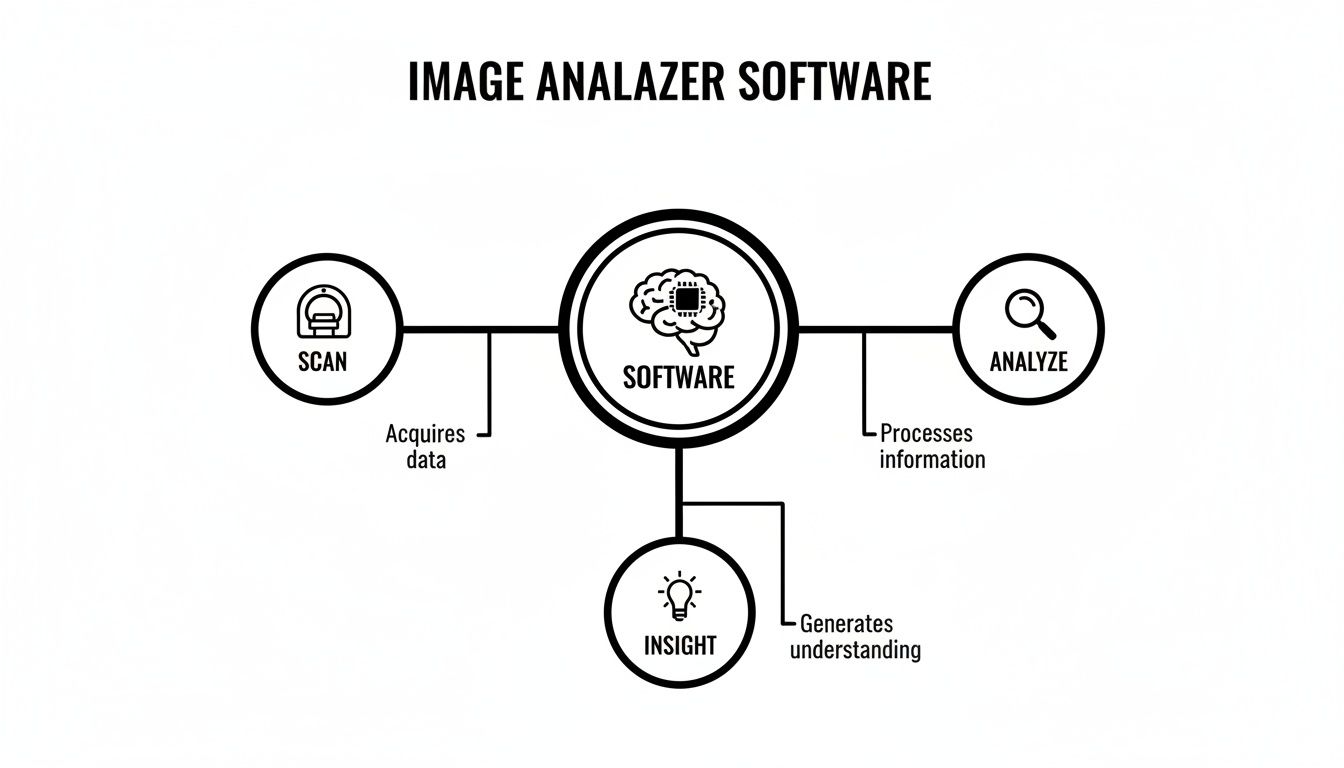
This flow shows how structured data moves through the system, with each step adding a new layer of value until the software delivers a clear, actionable answer.
The Intelligence Layer: Artificial Intelligence
If DICOM provides the structure, artificial intelligence (AI) brings the brainpower. AI algorithms are the expert interpreters who can read the DICOM language and find profound meaning hidden within the images. These aren’t just simple programs; they are sophisticated models trained on immense datasets of medical scans.
At its heart, image analyzer software is a sophisticated engine for data analysis, and understanding this is key. This excellent guide to collecting and analyzing data offers great perspective on the core principles that drive these systems. The software learns to spot the tell-tale patterns of disease, much like a seasoned radiologist builds an intuition over decades of practice.
Think of a Convolutional Neural Network (CNN)—a workhorse AI model in imaging—as a digital apprentice. It studies thousands of examples of healthy and diseased tissue until it can spot the subtlest differences with superhuman accuracy.
This intelligence layer is where the real magic happens. It’s what elevates imaging from simply descriptive to truly predictive.
Key AI Algorithms in Action
Different AI algorithms are built for specific jobs within the analysis workflow. Knowing what they do helps clarify how the software gets its amazing results.
- Image Recognition: This is the most basic task. The AI learns what’s in an image, classifying a scan as a brain MRI or a chest X-ray and identifying major anatomical structures.
- Object Detection: Taking it a step further, these algorithms don’t just classify the image; they locate and draw a box around specific things we care about, like a tiny nodule in a lung scan.
- Segmentation: This is where things get really powerful. Segmentation algorithms can precisely trace the exact boundaries of an object, like a tumor or an organ. This allows for incredibly accurate measurements of size, volume, and growth over time—metrics that are absolutely vital for planning treatment.
These components all work together to build a detailed, multi-layered understanding of every single image. For anyone wanting to grasp the full ecosystem, it’s worth exploring the relationship between PACS and DICOM and seeing how they form the backbone of our modern medical imaging infrastructure.
This powerful combination of standardized data and intelligent algorithms is what’s fueling today's medical breakthroughs. At PYCAD, we specialize in weaving these elements together. We build custom web DICOM viewers and integrate them into medical imaging web platforms, creating secure, intuitive tools that bring this advanced analysis to the fingertips of clinicians and researchers, helping them push the boundaries of patient care.
Weaving Analysis Tools Into Your Clinical Workflow
Even the most brilliant image analyzer software is only as valuable as its connection to the real world of patient care. An incredible algorithm sitting in a lab doesn't help anyone; its true power is unlocked only when it fits perfectly into the fast-paced, high-stakes environment of a hospital or clinic.
The real goal is to make advanced analysis a natural, almost invisible, part of a clinician's daily routine. This means building a bridge between sophisticated software and the existing healthcare IT systems that providers rely on every single day. Without this connection, even the best tool becomes just another information silo, creating more work instead of making life easier.
From Disconnected Data to Unified Intelligence
Think about the typical "before" picture. A radiologist might analyze a scan on one screen, then have to manually type their findings into the Electronic Health Record (EHR). The images themselves live in a separate Picture Archiving and Communication System (PACS). This disjointed process is not only slow but also a recipe for human error, causing frustrating delays between departments.
Now, imagine the "after" with a fully connected system. The image analyzer software speaks directly to the PACS, pulling scans the moment they’re available. Its AI-driven findings are then sent straight into the patient's EHR, instantly visible to the entire care team. This creates a single source of truth, speeding up the entire journey from initial scan to treatment plan.
The real inspiration lies in creating a frictionless flow of information. When technology works in harmony with clinical practice, it doesn't just improve efficiency; it elevates the standard of care, giving clinicians more time to focus on what truly matters—their patients.
This isn't a "nice-to-have" anymore. It's an absolute must for modern healthcare.
Building a Connected Ecosystem
To make this seamless integration a reality, we need to focus on two critical arteries of the hospital's digital anatomy: the PACS and the EHR.
When evaluating a new image analysis tool, it's crucial to think beyond the algorithm and consider how it will plug into your existing infrastructure. The table below outlines the major challenges and best practices for creating a truly integrated system.
Table: Key Integration Considerations for Image Analyzer Software
| Integration Point | Key Challenge | Best Practice Solution |
|---|---|---|
| PACS (Picture Archiving and Communication System) | Ensuring reliable, secure access to DICOM images without disrupting existing workflows. | Implement a robust DICOM query/retrieve protocol; use a middleware layer or vendor-neutral archive (VNA) to standardize communication. |
| EHR (Electronic Health Record) | Pushing structured findings and reports into the patient record in a standardized format (like HL7). | Utilize APIs or HL7 interfaces to automate data transfer; ensure the software can generate reports compatible with the EHR's format. |
| RIS (Radiology Information System) | Syncing analysis requests and results with scheduling and billing information. | Establish a bidirectional interface to share order information and report statuses, ensuring the entire imaging loop is closed. |
| Data Security & Compliance | Protecting sensitive patient data (PHI) during transfer and analysis, adhering to HIPAA and other regulations. | Employ end-to-end encryption for all data in transit and at rest; ensure the software vendor provides a Business Associate Agreement (BAA). |
Ultimately, a successful implementation feels less like adding a new tool and more like upgrading the entire nervous system of the clinic.
A solid integration strategy ensures data flows effortlessly between these systems, building a reliable digital foundation for patient care.
- PACS Integration: This is the bedrock. The software must be able to find, pull, and send DICOM images back to the central PACS archive without a single hiccup. Our guide on https://pycad.co/pacs-integration/ dives deeper into making this vital connection work flawlessly.
- EHR Integration: This connection is what closes the loop. It ensures that the results from the analysis automatically land in the patient’s complete medical record, which is essential for making sound clinical decisions and tracking progress over time.
The growth of AI is putting this integration into hyperdrive. The AI-based image analysis market is set to skyrocket from USD 13.07 billion in 2025 to USD 36.36 billion by 2030. Hospitals are bringing in these tools to help manage billions of imaging studies, and the FDA is keeping pace, granting 171 approvals for AI devices in 2023 alone—a 30% jump from the previous year.
To get the most out of these systems, it’s worth exploring how to automate data entry with AI to move information from the analysis tools directly into patient records. This kind of automation wipes out tedious manual tasks and keeps the data clean and consistent.
We at PYCAD are building this future today. We build custom web DICOM viewers and integrate them into medical imaging web platforms, combining them with CRM solutions and powerful AI tools. Our mission is to build secure, unified systems that act as that single source of truth, giving healthcare professionals the connected tools they need to define the next era of patient care.
Where the Magic Happens: Real-World Wins in Patient Care
At the end of the day, the real test of any medical technology isn't the code or the algorithms—it's the impact on people's lives. And that’s where image analyzer software is making an incredible difference. We're not just talking about minor tweaks to the old way of doing things. We're seeing profound, tangible shifts in how diseases are found and fought, turning complex scans into clear, actionable roadmaps for healing.
Think about what this means for someone on the front lines. An oncologist, for instance, can now use an AI-powered tool to spot a tiny lung tumor, one that’s still in its earliest and most treatable stage. It might have been completely invisible to the naked eye. That single discovery can change everything for a patient, turning a long, difficult battle into a much more manageable one.
This isn't a far-off dream. It's happening right now, in hospitals and clinics everywhere, redefining what's possible in medicine.

A New Era Across Medical Specialties
The power of image analyzer software isn’t limited to one corner of medicine; it's igniting progress across the board. Specialists in virtually every field are gaining deeper insights and making clinical decisions with a new level of confidence.
-
Oncology: In cancer care, this is nothing short of a game-changer. The software can precisely segment a tumor on a CT scan, calculating its exact volume to track how it's responding to chemotherapy. This gives doctors the hard data they need to know if a treatment is working, allowing them to personalize care and pivot quickly if it's not.
-
Cardiology: For heart health, these tools can dive into cardiac MRIs to measure blood flow through the heart's chambers or quantify tissue damage after a heart attack. This hands cardiologists an objective, crystal-clear picture of cardiac function, helping them guide everything from medication choices to surgical plans.
-
Neurology: In the complex world of neurodegenerative diseases like Alzheimer's or multiple sclerosis, the software can map subtle changes in brain volume or track lesion activity over time. This level of detail helps neurologists catch these conditions earlier and monitor their progression with an accuracy that was once unimaginable.
Each of these examples tells the same story: a static image is transformed into a dynamic, data-rich narrative. This narrative empowers clinicians to stop just reacting and start being predictive and proactive in their care.
From Diagnosis to Discovery
The impact doesn't stop at the clinic door. Image analyzer software is also putting medical research into overdrive. Scientists are using it to analyze thousands of images from clinical trials, pinpointing biomarkers that predict how a patient will respond to a new drug. This helps fast-track the discovery of new therapies, getting life-saving treatments from the lab to patients who need them faster than ever before.
North America is leading this charge, holding a 38.7% revenue share in the medical image analysis market, thanks to a huge focus on AI and precision medicine. The momentum is undeniable. In 2023 alone, the U.S. Food and Drug Administration approved 171 AI-based medical imaging devices—a stunning 30% increase from the previous year. You can get more details about this growth from this in-depth market report.
This groundswell of support is creating an ecosystem of innovation, where every new tool and every new discovery pushes the boundaries of what we can achieve.
Building the Tools for a Brighter Future
These incredible applications don't just appear out of thin air; they are born from purpose-built technology. The solutions making the biggest waves are the ones designed with a deep, firsthand understanding of the clinical problems they're meant to solve.
That’s our mission at PYCAD. We build custom web DICOM viewers and integrate them into medical imaging web platforms. In short, we create the specialized, intuitive tools that clinicians and researchers need to make these breakthroughs happen.
By focusing on custom-built solutions, we empower our partners to turn their visionary ideas into powerful, real-world tools. We believe that the right software doesn't just improve a diagnosis—it inspires the next wave of medical innovation. You can see the kinds of high-impact solutions we’ve developed for our clients by exploring our work at https://pycad.co/portfolio.
Choosing the Right Image Analysis Partner
Picking the right partner for your image analyzer software is one of the most defining decisions you'll make. This isn't just about buying a product off a shelf; it's about building a relationship that will shape your clinical outcomes, your research potential, and your very position in the industry. It's a strategic move that demands a clear vision.
For any hospital IT department, medical device company, or research lab, the journey starts with a fundamental question: do you buy a pre-packaged solution, or do you build a custom one? An off-the-shelf tool might seem like the easy answer, but the complex, high-stakes world of medical imaging rarely bends to easy answers.
Let's be honest: a one-size-fits-all approach usually fits no one particularly well. Your workflow is unique. Your research goals are specific. Your standards for patient care are non-negotiable. When you choose a generic solution, you’re forced to adapt your processes to fit the software’s limitations, not the other way around. This inevitably leads to friction, missed opportunities, and a daily battle with a tool that was never truly built for you.
The Build Versus Buy Dilemma
The "build versus buy" debate is always at the heart of this conversation. The pull of a ready-made solution is strong—it promises a quick start and lower upfront costs. But real, lasting value is almost always found in a platform that is meticulously crafted to fit your exact needs.
This is where partnering with a specialized firm to build your solution changes the game. It’s your chance to create a tool that meshes perfectly with your existing PACS and EHR systems. You can integrate your own proprietary algorithms and design a user experience that empowers your clinicians instead of holding them back. This is how you create a genuine competitive edge.
A custom-built solution is more than just software; it's a strategic asset. It becomes a living extension of your organization's unique approach to medicine and a launchpad for future innovation, freeing you from the constraints of a third-party vendor's roadmap.
At PYCAD, this is precisely what we do. We build custom web DICOM viewers and integrate them into medical imaging web platforms, creating systems as unique as the clients we serve. We believe the future of medicine won’t be won with generic tools, but with purpose-built solutions that accelerate discovery and elevate care.
A Practical Evaluation Checklist
To move forward with confidence, you need a structured way to look at potential partners. This checklist isn’t just a list of features; it's a framework for thinking through what really matters for your clinical, operational, and strategic goals.
Use these points to kickstart conversations with your team and size up any potential partner.
- Scalability and Performance: Can the system handle your current image volume and grow with you? Ask tough questions about its architecture and how it performs under pressure with massive datasets. A system that bogs down is a direct threat to clinical efficiency.
- Security and Compliance: Does this partner truly speak the language of healthcare regulations? They must be fully compliant with HIPAA and GDPR, offer a Business Associate Agreement (BAA), and use robust security like end-to-end encryption to guard patient data.
- Customization and Flexibility: How much say will you have over the features and workflow? A real partner works with you to tailor the solution, not box you into a rigid template. This freedom is essential for building a system your team will actually want to use.
- Integration Capabilities: Will this platform play nice with your existing IT ecosystem? Look for powerful APIs and a proven track record of connecting with a variety of PACS, EHR, and RIS vendors. A disconnected system is a non-starter.
- Support and Collaboration: What happens after the launch? The best partnerships are ongoing. Look for a team that offers dedicated support, collaborative development, and a genuine commitment to helping you succeed long after the initial project is complete.
Ultimately, choosing the right partner is about bringing your vision for the future of medical imaging to life. By carefully weighing these key areas, you can find a firm that won't just sell you software, but will help you build a lasting foundation for innovation.
You can see examples of the high-impact, custom solutions we've brought to life by exploring our work at https://pycad.co/portfolio.
Let's Build the Future of Medical Imaging, Together
If this journey through the world of image analyzer software has shown us anything, it’s that a one-size-fits-all approach just doesn't work. The potential here is absolutely massive, but it only comes alive when we design tools with intention and a deep understanding of the people who use them. This isn't about bolting on new features; it's about crafting solutions that feel like a natural extension of a clinician's own mind and hands.
And that’s exactly where we love to be. At PYCAD, we don’t just sell software—we build partnerships. Our entire mission is to stand shoulder-to-shoulder with healthcare innovators like you and forge the precise tools needed to push medicine forward.
Your Vision, Brought to Life
We’ve learned that the most incredible breakthroughs happen when great minds come together. Our entire process is built on listening, on deeply understanding your specific challenges, and then translating that vision into a platform that's powerful, secure, and genuinely easy to use. We’re here to build systems that free your team to do their best work, not box them in.
The future of healthcare isn't just about technology; it's about the seamless fusion of clinical wisdom and engineering excellence. It’s about creating an ecosystem where data flows effortlessly, AI acts as a trusted assistant, and clinicians are empowered to make faster, more confident decisions for their patients.
Making this a reality means getting our hands dirty and building specialized tools from the ground up.
- Secure Web Platforms: We engineer HIPAA-compliant platforms that put patient data security first, all while delivering the flexibility of the cloud.
- Advanced DICOM Viewers: We build custom web DICOM viewers designed for speed, precision, and the exact features your unique workflow requires.
- AI Development and Integration: Our team doesn't just plug in algorithms; we weave sophisticated AI models directly into your platform, turning raw pixel data into clear, actionable insights.
At PYCAD, our specialty is bringing these elements together. We integrate them into medical imaging web platforms to create a single, cohesive environment that truly elevates what's possible. We are all in on a future where technology empowers medical professionals to achieve things that were once unthinkable.
We invite you to see what this looks like in the real world. Take a look at our portfolio to see how custom-built solutions have helped others turn their vision into a reality and drive the future of healthcare.
Ready to see for yourself? Explore our projects.
A Few Common Questions
Diving into image analyzer software, especially with patient data and critical workflows on the line, naturally brings up some big questions. Getting straight answers is key to moving forward with confidence and, ultimately, improving how we care for patients.
Let's tackle some of the most common things that hospitals, research teams, and medtech innovators ask when they start exploring these tools.
Can We Plug in Our Own AI Algorithms?
Yes, you absolutely can—and you should be able to. This is where the real magic happens. Think of a great software platform as a launchpad, not a locked box. The most valuable solutions are built with open APIs and flexible frameworks specifically so you can integrate your own custom-built AI models.
This is a game-changer for research hospitals creating brand-new diagnostic techniques or for medical device companies wanting to wrap their unique algorithms into a product that’s ready for the market. It lets you marry your own specialized insights with an infrastructure that's already robust, compliant, and ready to scale.
How Do You Handle Patient Data Security?
In healthcare, data security isn't just a feature; it's the foundation of everything. Any platform worth its salt must be built around strict adherence to regulations like HIPAA in the U.S. and GDPR in Europe. This isn't just a checkbox; it's a deep, multi-layered strategy.
- End-to-End Encryption: Data has to be locked down at all times. That means it’s fully encrypted while it's sitting on a server (at rest) and while it’s moving between your PACS, the analysis platform, and the EHR (in transit).
- Strict Access Controls: Not everyone should see everything. Strong user authentication and role-based permissions make sure that only the right people can access or modify specific patient information.
- Comprehensive Audit Trails: The system needs to keep a detailed diary. It logs every action, showing exactly who accessed what data and when, which is absolutely essential for accountability and compliance.
At the end of the day, a secure system is built on trust. It's about giving you the freedom to push the boundaries of medicine while knowing you're upholding the highest standards of patient privacy.
What Does the Implementation Process Look Like?
Getting started is a partnership. It shouldn't feel like you're just being handed a piece of software. It usually kicks off with a deep-dive discovery phase where your technology partner really gets to know your clinical workflows, your current IT setup, and what you’re trying to achieve. From there, it's a step-by-step deployment, starting with the crucial connections to your PACS and EHR systems.
Here at PYCAD, for example, we specialize in building custom web DICOM viewers and integrating them into medical imaging web platforms. Our whole process is about working hand-in-hand with your team. We configure the system, train your people, and make sure the whole transition is smooth, causing as little disruption to your daily work as possible. You can get a feel for how we work by looking at our portfolio.
At PYCAD, our passion is building secure, custom-fit medical imaging platforms that help turn visionary ideas into real-world breakthroughs. We encourage you to see what we've built and imagine what a true partnership could mean for redefining patient care.