
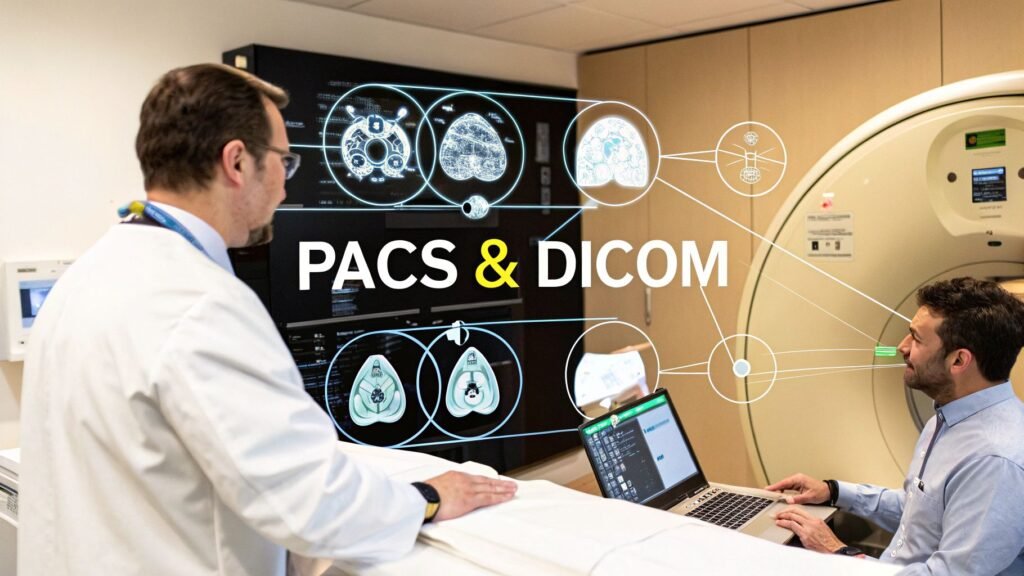
PACS (Picture Archiving and Communication System) is the hospital’s digital library for scans. DICOM (Digital Imaging and Communications in Medicine) is the language those scans are written in — file format and network protocol. One without the other is a pile of unreadable files, or a protocol with nowhere to live.
If you meant how to integrate PACS (HL7 / worklist / DICOMweb) → PACS integration. If you meant how to train staff → PACS system training. If you meant VNA / vendor lock-in → what is a VNA. If you meant what DICOM is (file / protocol) → what is DICOM. If you meant RIS and PACS together → radiology information systems and PACS. If you meant imaging software to buy → medical imaging software.
Before PACS, a prior film meant a person walking a jacket down a corridor. After PACS, the same study is a query.
PACS vs DICOM
| Aspect | PACS (the library) | DICOM (the language) |
|---|---|---|
| Job | Store, retrieve, manage, and display studies | Standardize the file and the wire protocol |
| Analogy | Shelves, catalogue, reading rooms | The language every book is written in |
| What it is | Software + hardware + workflow | A standard: .dcm objects and DIMSE / DICOMweb services |
| Example | The hospital archive a radiologist queries | The CT instance itself, header plus pixels |
They are not competitors. A GE scanner and a Siemens workstation talk because both speak DICOM. The PACS is where that conversation is filed.
Four pillars
A PACS is four jobs wired together.
- Acquisition. Modalities (CT, MR, US, DX) write DICOM and send it. Not a JPEG.
- Archive. The vault. Recent studies on fast storage; older ones on cheaper tiers. Every instance is tied to a patient and a study, not a folder named after last Tuesday.
- Workstation. The diagnostic workbench: hang the study, window-level, measure, compare priors. The lightbox, with tools.
- Network. The pipe. Studies are large. The network has to be fast enough for a trauma CT and locked down enough for PHI.
Image journey
A patient is on the CT. The scanner wraps pixels plus demographics, study UID, and pixel spacing into DICOM objects. That is the envelope: image inside, address on the outside.
The modality then C-STOREs the study to the PACS. The archive checks the object, reads the header, and files it against the patient. Seconds, not a courier.
Later a radiologist C-FINDs by name or ID and C-MOVEs (or C-GET) the study to the workstation. Web viewers do the same job over DICOMweb (QIDO to search, WADO to fetch) — still one study, one patient, not a ZIP on a share.
PACS also talks to the RIS and the EHR in HL7 (orders, ADT, reports). That conversation — worklist, PID-3, DICOMweb — is PACS integration, not this page.
On-prem, cloud, hybrid
| Model | Advantage | Cost | Fits |
|---|---|---|---|
| On-prem | Data stays in the building; LAN speed; no internet in the path | CapEx, staff, slow to grow a rack | Large hospitals with a real IT shop and a sovereignty rule |
| Cloud | OpEx, someone else patches, scale on a ticket | You need the WAN; subscription never stops | Clinics and teleradiology that refuse a second data centre |
| Hybrid | Hot studies local, priors in the cloud; a real DR story | Two environments to keep honest | Sites that want yesterday’s CT in 2 s and last year’s in 20 |
There is no default winner. The model is a budget and a latency number, not a brand.
Specialty PACS, briefly
Radiology is still the largest “-ology.” Cardiology wants motion and ejection fraction. Digital pathology wants gigapixel slides. Ophthalmology wants OCT thickness over time. A generic X-ray viewer is the wrong workbench for those. Unified platforms exist so a patient is one record, not three departmental islands — that long-term store is often a VNA.
AI sits on the same pipe
A model that flags a PE or measures a nodule is useful only if the result travels with the study (often a DICOM SR or SEG). That is a PACS workflow problem, not a second archive. This page names it. It does not become an AI product list.
FAQ
PACS vs VNA?
PACS is the departmental workbench. A VNA is the enterprise library that outlives one vendor’s viewer. Same pixels, different job — what is a VNA.
Can I view studies in a browser?
Yes. DICOMweb plus a zero-footprint viewer is how most new platforms do the last mile. No thick client on the ward laptop.
How is the data locked down?
DICOM TLS on the wire is the start. HIPAA / GDPR want audit trails, role-based access, and a plan for anonymization when the study leaves the clinic. The standard is not the whole fortress.
PYCAD builds the imaging side of this when the archive has to live in a clinic app. Case studies.