
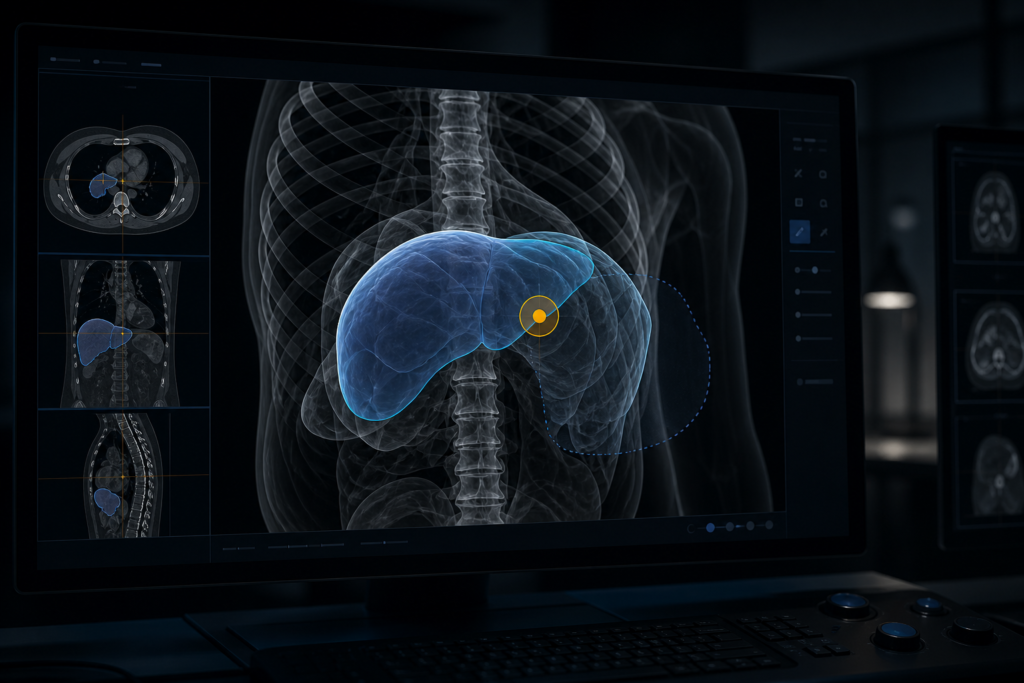
If you hang interactive 3D segmentation in a DICOM viewer, the wait after a click is the product. Dice after 50 simulated clicks is a table cell. The annotator feels 0.31 s versus 0.06 s, and they feel the restart when a bad click cannot come off.
SLIP (Segmentation with Low-latency Interactive Prompting) is the IRCAD France paper from Baptiste Podvin, Toby Collins, and colleagues at Université de Strasbourg, Humanitas, and Gemelli. It is on arXiv as 2607.22332. Code is at github.com/IRCAD/SLIP. The GUI is a 3D Slicer 5.6.2 segmentation plugin with point clicks and prompt undo. They compare against nnInteractive, SegVol, and SAM-Med3D.
nnInteractive is still the stronger first-click model, and it is the faster annotator on MRI uterus in their user study. SLIP’s case is latency, continued refinement after the other model plateaus, and undo that does not store a 20 GB session.
Encode once, click on cached patches
Most 3D-native interactive methods jointly encode the image and the prompt. After every click the volume, or a growing region of interest, goes back through the encoder. That is why nnInteractive’s authors said prompt removal would mean caching full intermediate states, which they called impractical for large volumes.
SLIP splits the job. The volume is cut into overlapping anisotropic patches of 32x192x192. A shared residual CNN plus FPN encodes each patch once. Those features stay cached for the session. A click only revisits the patches that contain the prompt, then walks a breadth-first queue of neighbors.
For each target patch a six-entry memory bank (about 2 MB in Bfloat16) holds high-confidence prompted patches and recently inferred neighbors. A small contextualization network and a two-layer 3D transformer mask decoder update the mask, an IoU-style confidence, and a patch-level object/background flag. Gaussian-weighted fusion, same idea as nnU-Net, stitches the patches. The encoder does not run again. The authors also treat this split as a way to swap image encoders later without retraining the whole click path.
Because only affected patches change, undo can store compressed deltas instead of full volumes. The paper quotes about 140 MB for 20 CT clicks. Caching nnInteractive-style full states for the same session would be about 20 GB.
The overlay has to stay cheap after the first encode. RadYOLO makes that argument for a first-pass box. SLIP makes it for the click loop after you already have a mask to refine. AMPLIFAI is the other direction. It ships feature masks you can hang before you train a category head.
Simulated 50 clicks on 13 held-out sets
They follow the usual simulated-click protocol: first positive click inside the structure, then clicks in the largest false-negative or false-positive region, up to 50. FM3BIS at CVPR 2025 used a budget of 5. They argue 5 is too short if each click is cheap. Eval is 13 public datasets that are not in training: ten CT sets (Pengwin, colorectal liver metastases, ACC-Ki67, HCC liver, HCC lesion, RIDER lung, TRUSTED, LNQ, SegRap, TUMSeg), HANSEG MRI, and two ultrasound sets (VTUS, UterUS). Hardware is an A100 workstation, methods run sequentially.
Cross-dataset means from Table 1:
- Latency: SLIP 0.06 s/click, nnInteractive 0.31 s, SegVol 0.29 s, SAM-Med3D 0.12 s. That is about 5.2x versus nnInteractive.
- After 50 clicks, cumulative wait: 2.9 s versus 15.2 s.
- Final DSC: 0.90 versus 0.88. If you still mix the coefficient with the training loss, read the note on Dice versus Dice loss.
- DC-AUC@50: nnInteractive 0.86, SLIP 0.85.
nnInteractive is slightly ahead for the first ~25 clicks and wins DC-AUC@50 on 9 of 13 datasets (SLIP on 4). It plateaus around 25-30 clicks. SLIP keeps moving and posts the highest DSC@50 on 11 of 13. nnInteractive is highest on 7 of 13 when you count three-digit ties. SegVol and SAM-Med3D sit well below both (final DSC 0.66 and 0.25).
CPU click path: image features precomputed (on GPU in their write-up), memory bank off. SLIP is 0.12 s/click. nnInteractive is about 15 s under the same CPU interaction setting. Use that figure if the annotator laptop has no GPU after a server encode.
Six annotators, three tasks, real undo
Simulated clicks do not undo, get tired, or restart a case. The user study is six people (three radiographers, three junior surgeons) at IRCAD France in Strasbourg and IRCAD Africa in Kigali. No senior radiologists or experienced surgeons; the authors say so. Each person annotated every case with manual 3D Slicer, nnInteractive, and SLIP. Method order was randomized. nnInteractive users could restart a case up to three times because that plugin has no prompt undo.
Three tasks, 15 cases each:
- Ultrasound focal liver lesions: held-out clips from FLL-US (1-3 lesions per clip, mean 4.0 s). This one is task-supervised. SLIP saw task-specific training data first. An arrow marked each target lesion so the test is segmentation, not detection.
- MRI uterus: public UT-EndoMRI, general model.
- CT liver lesions: public IRCADB1, general model.
Linear mixed-effects models, time versus manual:
- US: SLIP -79.0%, nnInteractive -80.1%. No significant difference between them.
- MRI uterus: SLIP -23.9%, nnInteractive -66.6%. nnInteractive needed about four times fewer clicks (8.02 versus 36.77) and was 56% faster than SLIP.
- CT lesions: SLIP -62.3%, nnInteractive -62.8%. Again no significant difference on the mean.
The CT mean hides the failure mode. nnInteractive had 0.61 restarts per image and three cases where the mask kept bleeding into liver parenchyma. Those runs hit 2961 s even after restarts. SLIP had 1.23 undos per image, no comparable failures, and a max of 1979 s. Restarts on nnInteractive were 0.09/image on US and 0.04 on MRI uterus. SLIP undos were 0.68 and 0.76 on those tasks.
Agreement with a STAPLE consensus of the six manual masks (not the public labels): US DSC 0.832 SLIP vs 0.834 nnInteractive (not significant). MRI uterus, nnInteractive higher (p < 0.001). CT, 0.827 vs 0.763, not significant, with three nnInteractive DSC outliers and none for SLIP.
End-of-study Likert, all six people: low latency 6.3/7, iterative refinement even when the first mask is wrong 6.6/7, reversible prompting 7.0/7. Task questionnaires favored SLIP on US and CT, and favored nnInteractive on MRI uterus, which matches the times.
How this lands in Slicer or a viewer
Treat SLIP as a click-refine layer in Slicer or a viewer, not as a replacement for a dense organ model you already trust. The first encode still costs GPU memory. The paper says volumes up to about 512x512x512 fit in 10 GB if you keep the patch embeddings resident. After that, the click path is the cheap part.
If your annotation queue is uterus-like MRI, nnInteractive is the better current tool in this study. If the queue is liver lesions on US or CT, the two methods land on similar clock time, and SLIP’s undo is the thing annotators rated 7.0. PatchChestCT and CT-ΔBench are about labels you can hang or compare. This paper is about the minutes you spend drawing them.
The comparison is complete systems, not a matched-data architecture bake-off. nnInteractive’s training pipeline is not public, and some of its training sets are gone. SLIP was trained from scratch on a mixed public pile plus extra ultrasound from IRCAD France and Humanitas. The US user-study result is the task-supervised split. Do not read it as a zero-shot US claim.
The arXiv text is a preprint. The authors used ChatGPT only to edit English. No device claim, no cleared clinical product. Time the click loop on your own stack, I/O included, before you swap a Slicer plugin.
Sources
- Podvin, B., Ancel, A., Milana, F., Innocenzi, C., Arrigo, D., Espinela Schulze, F., Torzilli, G., Marescaux, J., George, D., Hostettler, A., Collins, T. SLIP: Segmentation with Low-latency Interactive Prompting for 3D Medical Images. arXiv:2607.22332. https://arxiv.org/abs/2607.22332 (HTML: https://arxiv.org/html/2607.22332)
- Code: https://github.com/IRCAD/SLIP
- Isensee, F., et al. nnInteractive: Redefining 3D Promptable Segmentation. arXiv:2503.08373. https://arxiv.org/abs/2503.08373