
Cardiac segments
Cardiac segments are the AHA 17-segment map of the left ventricle: a shared language for wall motion, perfusion, and coronary territory. It is not a chamber mask. It is not a volume or an ejection-fraction number. If you meant label LV / RV / myocardium on cine MRI or CT → heart segmentation. If you […]
Hospital scribe

A hospital scribe is the person in the room (or on a secure line) who writes the encounter into the EHR while the physician talks to the patient. The job is real-time documentation in a hospital — ED, ward, clinic attached to the building — not a career-advice page and not an ambient-AI product. If […]
Effective lung segments on ct: A Practical Guide
Decoding Lung Segments on CT: Foundational Anatomy Understanding lung segments on CT scans begins with a firm grasp of bronchopulmonary anatomy. Imagine the lungs as an inverted tree: the trachea, the trunk, branches into the right and left main bronchi. These bronchi divide into progressively smaller airways, ultimately reaching the bronchopulmonary segments. These segments, the […]
What a volumetric CT scan is

A volumetric CT scan is how the gantry acquires a volume: the table moves while the tube spins (helical / spiral), a multi-detector row grabs many slices per rotation, and reconstruction writes a stack you can reformat. This page is that scan mode. It is not volume rendering (how you paint the volume afterward). If […]
Convert DICOM to STL Easily – Expert Guide
The Science Behind Converting DICOM to STL Medical imaging has evolved dramatically. We’ve moved beyond simply viewing images to actually creating tangible 3D models. This advancement relies on converting DICOM (Digital Imaging and Communications in Medicine) files, the standard for medical scans like CT and MRI, into STL (Stereolithography) files, the language of 3D printing. […]
Volume rendering of CT
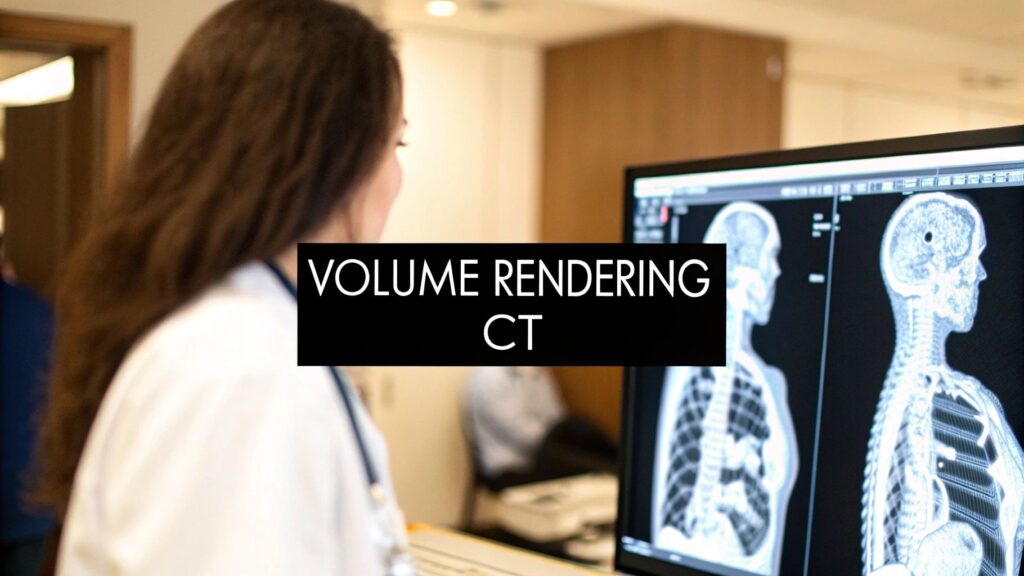
Volume rendering of CT paints every voxel in a scan — not just a surface — so you can see vessels, bone, and soft tissue in one 3D view. The useful knobs are MIP vs DVR, transfer functions, and (when you want film lighting) cinematic rendering. This page is that visualization. It is not how […]
Google Cloud Healthcare API

The Google Cloud Healthcare API is Google’s managed product for storing and exchanging clinical data as FHIR, DICOM, and HL7v2 stores. It is not a generic “healthcare API” explainer, and it is not a PYCAD product. If you meant healthcare APIs in general (FHIR vs REST, why integrate) → API for healthcare. If you meant […]
Medical scribe

A medical scribe is a career: how people get the job, what a shift actually is, and why so many of them are trying to get into a health-professional school. It is not the hospital-role explainer. It is not an ambient-AI product. It is not a PYCAD hiring page. If you meant the role in […]
API for healthcare
An API for healthcare is a messenger between systems that were never designed to talk. Think of a waiter: one system places an order (a request), the kitchen (another system) prepares it, and the waiter brings the plate back. In a hospital that plate is a problem list, a lab result, a DICOM study pointer, […]
Cross section of skeletal muscle

A cross section of skeletal muscle is the cut that shows the connective-tissue layers, the fibers, and the sarcomeres that actually pull. This page is that anatomy — epimysium / perimysium / endomysium, ACSA vs PCSA, pennation, fiber types. It is not a medical-imaging modality survey. If you meant what a medical cross-section image is […]