
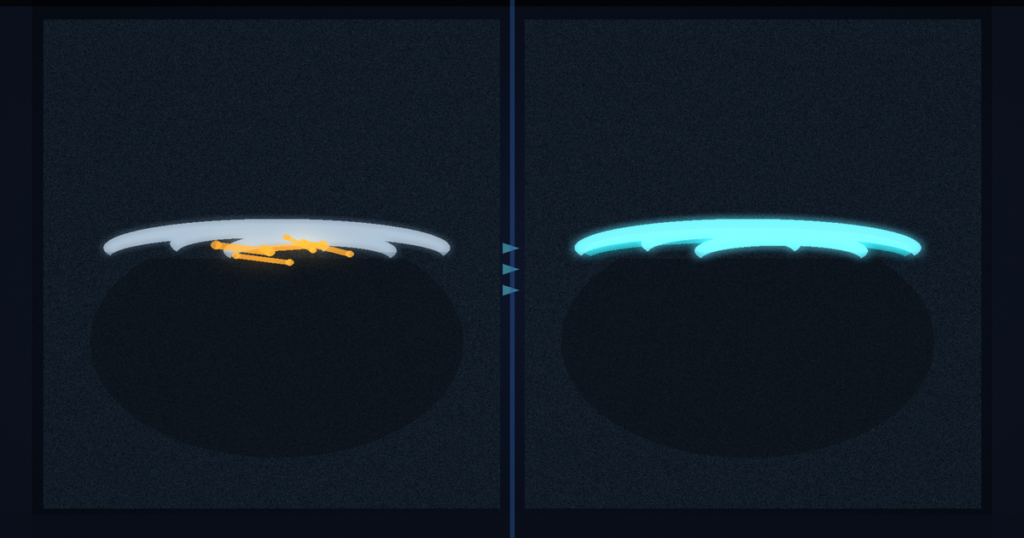
Hang a bone ultrasound frame for an orthopedic labeling pass. An expert paints a rough brush over the bright interface, not a pixel-perfect contour on the first stroke. ExiL takes that imperfect mask, the US image, and a few geometric cues, then returns a completed overlay the expert can accept or nudge. Arash Tavangar, Larissa K. Chiu, Hamidreza Khodashenas, Gregory K. Berry, and Amir Hooshiar (McGill University / RI-MUHC) posted arXiv:2609.00473 on 1 September 2026. The paper is Expert-like Bone Ultrasound Segmentation through Expert-in-the-loop Mask-conditioned Progressive Learning. No public code repository is linked in the preprint (checked 2 September 2026).
The method treats annotation as a refinement trajectory rather than a one-shot mask. A synthetic brush simulator trains a 7.8M-parameter U-Net to complete partial coverage. In deployment, an expert mode updates the decoder from accepted refinements so the assist drifts toward that annotator. Inference sits in the 10 to 50 ms range, which is fast enough to sit beside a live US labeling rail.
Brush trajectories become the training signal
Real intermediate brush states are rare in public medical datasets. ExiL builds them from UltraBones100k CT-aligned bone labels. For each ground-truth mask it computes a signed distance field, samples a target coverage band (10 to 30%, 40 to 60%, or 70 to 90%), and lays stochastic strokes with thickness 3 to 5 px, direction momentum, missing patches, and limited boundary leakage. The result looks like early rough painting or later cleanup, not simple erosion.
The completion network is a lightweight U-Net. Inputs concatenate the US image, the current brush mask, a distance-to-brush map, and an edge map. The network learns to map imperfect masks toward a final bone surface. Training uses about 2.5k frames sampled with stride 2 from a 5k-image subset, resized to 512×512, for 25 epochs. That scarce-label setup is deliberate: if full labels were cheap, expert-in-the-loop completion would matter less.
Expert mode keeps refining after the model ships
At annotation time the expert starts from a rough brush, calls the model, edits, and calls again until the mask meets the acceptance rule. Once a final expert-approved mask exists, expert mode updates only from those approved edits. The encoder stays frozen. The decoder takes five gradient steps at 10⁻⁴ per accepted mask. Intermediate states along the trajectory are paired with the final approved mask, and synthetic pairs teach the direction of correction from a coarser mask toward a finer one.
The loss mixes region Dice with a boundary Dice term (radius 3 px) plus a penalty that suppresses false positives above the bone interface. That combination pushes the overlay onto the upper bone surface instead of leaking into soft tissue.
Where the overlays held on cadaver and volunteer data
Quantitative autofill scores use held-out UltraBones100k cadaver frames with synthetic rough masks at the three coverage bands. Annotation timing uses a prospective volunteer set (three participants, 6 sequences each, 20 frames per sequence, 360 frames total) under a single-expert protocol with the same interface and stopping rules across methods.
On the synthetic autofill benchmark, the best trajectory-aware setting (ExiL v2) reaches about 0.87 mean Dice and 2.7 px boundary error overall, versus 0.79 Dice and 4.3 px for the non-progressive base completion model. On the volunteer timing study, average time per frame drops from 60 s manual-only to 20 s with ExiL v2 (66.7% reduction), with fewer autofill cycles per frame. Those timing numbers are a controlled within-annotator feasibility result, not a multi-user claim. Gains shrink when the initial brush already covers most of the bone; they grow when coverage is sparse. Extremely thin or anatomically inconsistent brushes still fail more often.
How this lands in a viewer
If you already hang intraoperative or point-of-care bone US in a DICOM viewer, treat ExiL as a brush-conditioned completion rail on the labeling path. Load the frame, accept a rough brush (or seed one), run the mask-conditioned U-Net, hang the refined overlay, let the expert accept or edit, then optionally push an expert-mode update from the approved mask. Fail closed when the brush is nearly empty, when the bright bone interface is missing or heavily shadowed, when the anatomy sits outside the tibia-style UltraBones distribution the model saw, or when you need multi-structure 3D volumes rather than a 2D bone surface mask. Do not treat the single-expert 20-second timing as a clinic-wide throughput guarantee.
ZODIAC hangs a complete lumbar mesh from partial intraop US. SCoPE-Reg places an untracked 2D US slice in six-DoF on a 3D volume. This paper is rough bone brush in, refined surface overlay out, with online adaptation from accepted edits.
Rebuild from arXiv:2609.00473. As of 2 September 2026 the abstract and PDF respond (HTTP 200). No public code link appears in the preprint. The preprint is the source of record until a camera-ready version exists.
Sources
- Tavangar, A., Chiu, L. K., Khodashenas, H., Berry, G. K., Hooshiar, A. Expert-like Bone Ultrasound Segmentation through Expert-in-the-loop Mask-conditioned Progressive Learning. arXiv:2609.00473, posted 1 September 2026. https://arxiv.org/abs/2609.00473 (HTTP 200 on 2 September 2026). PDF: https://arxiv.org/pdf/2609.00473 (HTTP 200 on 2 September 2026). No public code repository linked in the preprint.
- Wu, L., et al. UltraBones100k: a reliable automated labeling method and large-scale dataset for ultrasound-based bone surface extraction. Computers in Biology and Medicine 194, 110435, 2025. DOI: 10.1016/j.compbiomed.2025.110435 (DOI resolve HTTP 200 on 2 September 2026).
- Isensee, F., et al. nnU-Net: a self-configuring method for deep learning-based biomedical image segmentation. Nat. Methods 2021. DOI: 10.1038/s41592-020-01008-z
- Shahin, A. H., Zhuang, Y., El-Zehiry, N. From sparse to precise: a practical editing approach for intracardiac echocardiography segmentation. MICCAI 2023. (Cited interactive US editing baseline in the paper.)