
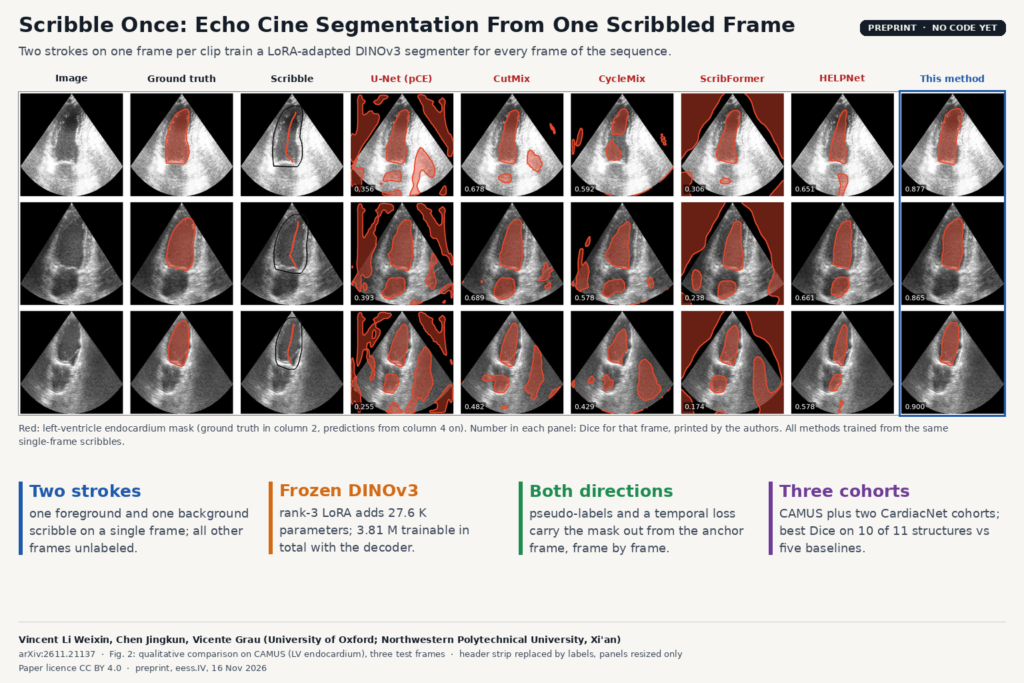
In echocardiography segmentation, most of the cost is labelling. A single cine loop can hold dozens of frames, and a cardiologist or sonographer has to trace the left ventricle, the atrium and sometimes the right heart on each of them through speckle and dropout. Weakly supervised methods cut the cost per frame by asking for scribbles instead of full outlines, but they still want a scribble on every training frame, so the work still grows with clip length. A preprint from the University of Oxford and Northwestern Polytechnical University in Xi’an, arXiv:2611.21137 (eess.IV, 16 November 2026), trains a sequence segmenter from two scribbles on one frame per clip and leaves every other frame unlabeled.
What it does
The method, which the authors call “Scribble Once, Segment the Sequence”, takes an echo clip in which only one frame, the anchor, carries annotation. That annotation is one foreground stroke inside the structure of interest and one background stroke outside it. Everything else in the clip has no label at all. During training, the framework turns those two strokes into dense pseudo-labels for the anchor frame, then pushes that supervision forward and backward through the clip, frame by frame, while letting the chamber change shape as the heart beats.
The anchor can be any frame. The middle frame is the default because it halves the distance supervision has to travel, and the authors note that an end-diastole or end-systole frame can be the anchor instead.
How it works
- A frozen foundation encoder. The backbone is DINOv3 ViT-B/16, a general-purpose self-supervised vision model, kept frozen. The authors chose a general model instead of an echo-specific one so the recipe stays modality-agnostic. Grey ultrasound frames are copied into three channels and resized to 512 by 512, which gives a 32 by 32 grid of tokens.
- Small adapters. Rank-3 LoRA adapters sit on the query and value projections of transformer blocks 3, 6 and 9. That adds 27.6 K trainable parameters, 0.03% of the 85.7 M backbone. Features from those three blocks are resampled into a four-level pyramid (the coarsest level by average pooling) and fed to a small U-Net-style decoder. The whole trainable part is 3.81 M parameters, against 7.76 M for the U-Net used by the CutMix and CycleMix baselines and 47.91 M for ScribFormer.
- Mean teacher. A student network learns by gradient descent and a teacher copy follows it as an exponential moving average. The student sees frames with brightness, contrast and noise changes; the teacher sees clean frames.
- Connectivity-filtered pseudo-labels. On the anchor frame, only predicted blobs that touch the foreground scribble are kept. On the next frame, only blobs that overlap the kept mask of the previous frame survive, and so on outward in both directions. Teacher and student masks are filtered this way and then mixed pixel by pixel, and the student is trained against the mix with a Dice loss on every frame.
- Anchor-relative temporal loss. Each frame is compared with its neighbours on the side facing the anchor, with closer neighbours weighted more. Three safeguards keep this from freezing the heart in place: only confident pixels that agree with the reference count, predictions are pooled over small cells so a slight wall motion costs nothing, and differences below a margin are ignored.
- Boundary term. A gated CRF loss encourages nearby pixels with similar intensity to share a label, which fills the gap between the two strokes using the image itself.
Training ran for 40 epochs with AdamW on a single NVIDIA RTX PRO 5000 Blackwell GPU. The temporal machinery is a training device. The model that comes out is a per-frame 2D segmenter.
What they tested it on
Two public datasets, three cohorts. CAMUS (500 patients) was used through its two-chamber half-sequences, with masks on every frame for the left-ventricular endocardium, epicardium and left atrium. CardiacNet supplied an atrial septal defect cohort (135 sequences) and a pulmonary arterial hypertension cohort (299 sequences), with masks on about five frames per sequence for the four chambers. Splits were 70:10:20 for training, validation and test. In all cases the scribbles were derived from the existing masks and placed on one frame per training sequence.
The comparison set is a U-Net trained with partial cross-entropy alone, CutMix, CycleMix, ScribFormer and HELPNet, all given the same single-frame scribbles. Averaged over structures, the method reached a Dice of 0.784 on CAMUS, 0.744 on the septal defect cohort and 0.754 on the hypertension cohort. The strongest baseline on average, CutMix, scored 0.687, 0.406 and 0.562. It was best on 10 of the 11 structures and had the lowest average HD95 in every cohort.
The featured image (Fig. 2 of the paper) shows the baselines’ failure mode. With a scribble on one frame only, they over-segment, spilling red mask across the sector and sometimes across the whole image, which keeps recall high and destroys precision. The new method’s gain comes mostly from fewer false positives: average precision on CAMUS was 0.901, with recall in the same range as the other methods.
What it would change for an annotation or viewer workflow
For a team building an echo product, labelling cost often decides whether a new view or a new structure gets a model at all. With this recipe, labelling a training set means opening each clip, picking one frame and drawing two strokes. A web annotation tool needs a frame picker and a brush for it, nothing more.
The output is a mask per frame, which is what a viewer needs to draw a chamber contour over a cine loop and what downstream code needs for areas, volumes and ejection fraction. Because the model is small on top of a frozen public backbone, a site could keep one DINOv3 instance and swap tiny adapter and decoder sets per view or per structure.
A review loop fits on top. Run the model across a new batch of clips, show the contours in the viewer, and send only the clips where the contour looks wrong back for another scribble. The paper does not test that loop, but nothing in the method prevents it.
What it does not tell you yet
- The scribbles were generated from ground-truth masks, not drawn by clinicians. Real strokes from a busy sonographer will be messier, and the paper does not measure sensitivity to scribble quality or placement.
- CAMUS was used as two-chamber half-sequences, which run from end-diastole to end-systole. Full cycles, multi-beat loops and the four-chamber CAMUS view were not reported.
- On CardiacNet only about five frames per sequence have masks, so the temporal behaviour on those cohorts is checked on a handful of frames.
- The scribble map has one foreground class, so each structure is learned from its own pair of strokes. The tables report single numbers, with no spread over seeds or folds.
- HD95 is reported in pixels on resized 512 by 512 frames, not in millimetres, so it does not translate directly into a clinical tolerance.
- The ablation text and Table 3 disagree on the full-model CAMUS Dice (0.824 in the text, 0.851 in the table), so read the component-by-component gains with care.
- No clinical endpoint was tested. There is no ejection fraction, volume or strain comparison, only overlap and boundary metrics.
- The gated CRF loss helped on CAMUS and slightly hurt on the hypertension cohort, and the authors suggest the boundary term helps only when image edges are reliable.
How to try it
The paper links no code or weights, and searches on GitHub and Hugging Face on 17 November 2026 found no repository for it, so there is nothing to download yet. The implementation details are complete enough to rebuild it: DINOv3 ViT-B/16 weights are public, the LoRA placement, rank and decoder layout are specified, and the loss weights (1.0, 0.5, 0.1 and 0.1 for partial cross-entropy, Dice, temporal and CRF), EMA decay of 0.99 and mixing probability of 0.5 are given. CAMUS and CardiacNet are public. On the blog, see also P2Echo, one text-prompted model for four echo views and scribbling one slice to propagate volume masks.
Source and license
Paper: Vincent Li Weixin, Chen Jingkun and Vicente Grau, “Scribble Once, Segment the Sequence: Bidirectional Temporal Consistency for Weakly Supervised Segmentation in Echocardiography Sequences”, arXiv:2611.21137 (eess.IV, 16 November 2026), preprint, 10 pages. Affiliations: University of Oxford; Northwestern Polytechnical University, Xi’an. Paper licence: CC BY 4.0. Code and weights: not released, licence not stated. Data: CAMUS and CardiacNet, both public. Featured image: Fig. 2 of the paper, cropped and resized only.