
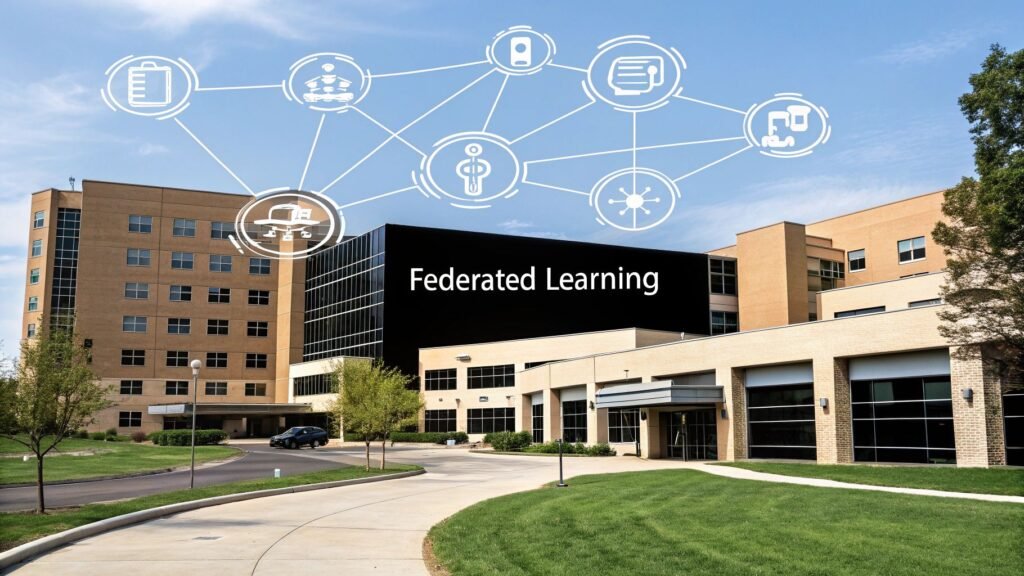
Federated learning in healthcare is a training pattern: the model travels to the hospital; the scans stay put. Each site trains on its own studies, sends weight updates (not pixels) to an aggregator, and a global model comes back. It is not a definition of machine learning for imaging. It is not the hospital AI stack. It is not a PYCAD federated platform.
If you meant what imaging ML actually returns (mark / mask / score) → machine learning for medical imaging. If you meant the broad healthcare AI stack → what is artificial intelligence in healthcare. If you meant the radiology product job (second reader, who signs) → artificial intelligence in radiology. If you meant how a model is trained as a lifecycle step → machine learning model training. If you meant strip identifiers from a file → what is data anonymization.
PYCAD builds custom web DICOM viewers and imaging models. That is a place a federated weight can land. It is not an FL orchestrator, and it is not a multi-hospital training network.
What actually moves
Centralized training wants a pile. You copy every DICOM to one GPU farm, you sign a data-sharing contract for each site, and one breach of that farm is every patient. Federated learning keeps the pile where it already is. The coordinator sends a starting model. Each hospital fits it on local studies, behind its own firewall. Only the update — gradients or weights — goes back. The aggregator averages those updates into a new global model and ships it out again.
| Centralized training | Federated learning | |
|---|---|---|
| Where the pixels sit | One server or one cloud bucket | Each hospital’s archive |
| What travels | The studies | Model parameters |
| Breach surface | The pile is the prize | Raw studies never leave the site. Updates can still leak — see below |
| Legal hop | A data-sharing agreement per site | A collaboration agreement; the file itself does not move |
| What you still owe | HIPAA / GDPR on the copy | HIPAA / GDPR on the local copy and on the update channel |
The loop is the whole method: distribute, train locally, aggregate, repeat. A slide that says “we do federated learning” without that loop is a costume.
The loop, without the librarian story
- Init. A coordinator holds a starting model for a named job (ICH on non-contrast head CT, nodule on chest CT). It does not hold the studies.
- Local fit. Each site trains on its own labeled studies. The pixels stay on that site’s disk. This is ordinary supervised training — the 673 page — run behind a hospital firewall.
- Update, not file. The site sends weights or gradients. Not the DICOM. Not the report.
- Aggregate. The coordinator averages (FedAvg is the usual name) and produces a new global model. One site with 50 studies should not outvote a site with 5,000 unless you meant to. How you weight the average is a design choice, not a slogan.
- Repeat. The new global model goes back out. Drift, a new scanner, a new protocol — you keep looping or the model goes stale.
Dayan et al., Nature Medicine 2021, is the COVID-era paper people cite: 20 sites, clinical-outcome prediction, federated weights. That is one published run. It is not a law that FL always beats a local model, and it is not a reason to buy a vendor.
Three layouts
| Layout | Who talks to whom | When it fits | What breaks |
|---|---|---|---|
| Hub-and-spoke | One coordinator; sites only talk to it | A named consortium with a lead site or a neutral host | The hub is a single point of failure and a bottleneck |
| Peer-to-peer | Sites exchange updates with each other | Two or three specialist clinics on one rare disease | Consensus gets messy as the ring grows |
| Heterogeneous | Same loop, but the data is not i.i.d. | Real hospitals: different vendors, protocols, case mix | A naive average learns the largest site’s quirks |
Healthcare data is heterogeneous by default. Scanner vendor, kVp, reconstruction kernel, and who walks in the door are not the same in two cities. A global model that only works on the coordinator’s GE is not a global model.
Privacy is a stack, not a fortress
Keeping the file local is the first control. It is not the last. Model updates can leak. A model-inversion attack tries to reconstruct training examples from the weights. That is a real research class, not a movie plot, and it is why FL is usually paired with other tools:
- Differential privacy. Calibrated noise on the update so one patient is mathematically hard to pin. Epsilon is the budget: lower is stronger privacy and a worse model. You pick the trade, you do not get both for free.
- Secure aggregation / SMPC. The coordinator sees the sum of updates, not each site’s vector. Useful when the threat is the coordinator itself.
- De-identification of the local copy. FL does not replace stripping identifiers before a study is used for training. That job is 6216 and the 683 how-tos (Python, tools).
HIPAA and GDPR care about whether PHI left the covered entity and who can reconstruct it. “We used federated learning” is not a BAA and it is not a DPIA. You still name the legal basis, the subprocessors on the coordinator, and what happens to the checkpoints.
How you know it worked
A single global accuracy is the wrong report card. Sites differ. A model that looks brilliant on hospital A and fails on hospital B is a site model with extra steps.
- Per-site performance. Precision / recall / AUC on each hospital’s hold-out, not just the average.
- Fairness across the mix you actually scan. Age, sex, scanner, protocol. A gap is a dataset problem.
- Communication cost. How many megabytes per round. A site on a bad uplink will drop out.
- Privacy budget. If you claimed an epsilon, write it down and keep it.
The model is not done at go-live. New studies arrive; the mix shifts; you re-fit or the flags drift. That lifecycle is 6178, not a second FL article.
What this page is not
- Not 673. Imaging ML is the mark / mask / score. This page is how you train when the studies cannot be copied.
- Not 670. The hospital AI stack (notes, labs, ops) is a different URL.
- Not 671. Who signs the report is still a person. FL does not change that.
- Not a PYCAD federated-learning product, multi-hospital network, or HIPAA platform. Dropped the Outrank images, Grand View CAGR, YouTube,
/portfolio, and the electronics-recycling outbound.
If a federated weight has to land in a clinic viewer on a DICOM study, that is the imaging piece. Case studies.