
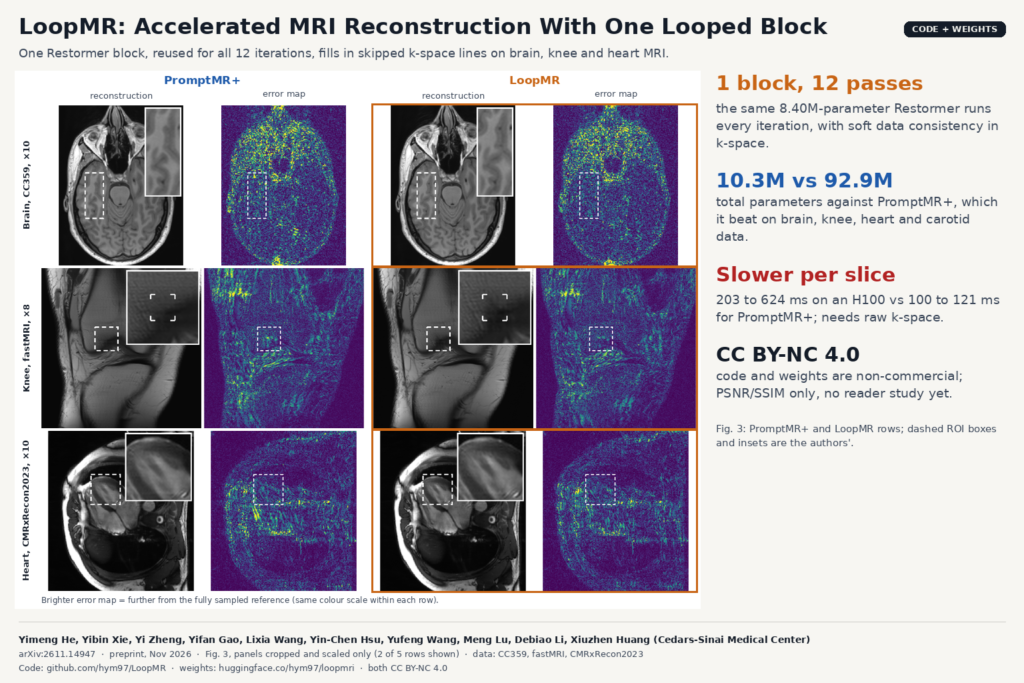
Every accelerated MRI product hits the same trade. You skip k-space lines to cut scan time, and a network has to fill in what you skipped. The networks that win the reconstruction challenges do it with a stack of cascades, each with its own weights, so the model gets bigger every time you add a step. PromptMR+, which won both tasks of the CMRxRecon2024 challenge, is at 92.9M parameters. A team at Cedars-Sinai Medical Center in Los Angeles tried the opposite: reuse one good block at every step. The result is LoopMR, described in arXiv:2611.14947, with code and weights public under a non-commercial license.
What LoopMR does
LoopMR is an unrolled reconstruction network. It takes undersampled multi-coil k-space and the sampling mask, and returns a coil-combined image. It starts from the zero-filled image and coil sensitivity maps, which come from the sensitivity estimator of PromptMR+ (1.87M parameters). Then it runs the same loop 12 times.
In each pass, one Restormer block, a transformer that computes attention across channels rather than across pixels so it stays affordable at full MRI resolution, looks at the current image estimate and a few extra inputs. Those are the estimate pushed back through the acquisition mask, the zero-filled image, the difference between the two, and four latent images that act as the block’s memory of earlier passes. The block returns an image update and new latents. The update goes back to k-space, where a soft data-consistency step pulls it toward the k-space lines that were measured. The same block and the same two learned step sizes are used in every pass.
The block has 8.40M parameters and the whole model 10.27M. The released models also take five adjacent slices as input; on cardiac data those are adjacent time frames or weightings rather than slices.
What they tested it on
Brain: 67 fully sampled 12-coil T1-weighted volumes from Calgary-Campinas (CC359), with the exact split and Poisson-disc masks used by PromptMR+ (47 train, 10 validation, 10 test) at ×5 and ×10. Knee: 199 proton-density volumes from the fastMRI validation set, split 159 / 40, at ×4 and ×8. Heart: CMRxRecon2023 cine and T1/T2 mapping, 100 patients for training and 20 (76 files) for testing at ×4, ×8 and ×10. Carotid: an in-house set of 45 3D MPRAGE vessel-wall volumes from 6 to 27 receive coils at different centres, with the GRAPPA ×2 clinical reconstruction as reference, tested at ×6 and ×12.
The baselines are E2E-VarNet, PromptMR and PromptMR+. LoopMR came out ahead in PSNR and SSIM on all four datasets at every acceleration, and the difference against PromptMR+ was significant everywhere (p < 0.01, Wilcoxon signed-rank). Its SSIM was higher than PromptMR+ on 137 of 138 test cases. The margin was largest on the carotid data, where PSNR went up by 0.84 dB at ×6 and 0.76 dB at ×12 over PromptMR+.
If you read scans, look at the qualitative figures. On a CC359 slice at ×10, PromptMR+ draws a temporal sulcus as broken where the reference shows it continuous; LoopMR keeps it whole. On a fastMRI knee slice that carries a radiologist annotation from fastMRI+, LoopMR renders the subchondral bone edema closest to the reference. On the carotid set, it depicts the vessel wall closer to the reference than the other three methods. The featured image above shows the brain, knee and heart cases from Fig. 3, with error maps where brighter means further from the fully sampled image.
The finding behind the model
The authors also ran a controlled comparison. They trained the same model with one shared block and with distinct blocks at 6, 12 and 24 iterations. The shared version matched or beat the distinct one at every depth, with 5 to 20 times fewer parameters (10.2M against 52M, 102M and 202M). They then repeated the test with four block types. Shared transformer blocks (Restormer, SwinIR) held up or did better; shared CNN blocks (E2E-VarNet and PromptMR+ blocks) did worse, though the gap narrowed as the block grew. Their reading is that per-iteration weights mostly make up for a block that is too small, which would explain why older shared-weight models like MoDL, at about 0.1M parameters, lagged.
Two other details are useful if you build reconstruction pipelines. Going from 12 to 24 iterations bought little; a bigger block helped more than more passes. And training with a loss on every iteration, not only the final one, gives a model that produces a usable image after about four passes and stays stable past 12, for a cost of about 0.1 dB at the trained depth. The authors suggest that could power a fast preview on the console while the full reconstruction finishes.
Why a viewer or clinic team should care
LoopMR works on raw multi-coil k-space, before anything becomes a DICOM series. A PACS or a web viewer never sees the input it needs. So the direct users are scanner vendors, research sites that export raw data, and teams building reconstruction for low-field or custom sequences.
For a shop that builds clinical platforms around MRI, three things still apply. A 10M-parameter model is easier to ship, version and validate than a 93M one, and its peak memory on an H100 was 0.7 to 3.0 GB. A single block that you can run for a chosen number of passes fits a preview-then-final workflow better than a fixed cascade. And if you run research MRI with raw data access, this is a reconstruction baseline with public code, released weights and per-volume result files you can rerun without a GPU.
What it does not tell you yet
- It is slower than PromptMR+. The saving is in parameters. Inference took 203 to 624 ms per slice on an H100, against 100 to 121 ms for PromptMR+.
- Training sets are modest (47 training volumes on CC359). Whether distinct weights win back the advantage with large multi-site data is open.
- Each model is trained for one dataset and one mask family (Poisson-disc on CC359, 1-D Cartesian elsewhere). The authors do not expect it to generalise to unseen anatomies or sampling patterns. It did hold its lead on unseen accelerations (×4 and ×16) and on fastMRI brain, which it never saw in training.
- All undersampling is retrospective, and the carotid data is not public.
- Quality was measured with PSNR and SSIM only. There is no radiologist reading, so hallucinated structure at high acceleration has not been assessed.
- The PDF uses an IEEE Transactions on Medical Imaging template, but the arXiv listing does not state acceptance anywhere. Treat it as a preprint.
How to try it
The repository at github.com/hym97/LoopMR has training configs for CC359, fastMRI knee and CMRxRecon2023, evaluation scripts that follow each dataset’s official protocol, and a notebook committed with its outputs that reconstructs a CC359 slice at ×5 and ×10 and shows the image after 1, 2, 4, 8 and 12 passes. Weights for the three public datasets are on Hugging Face at hym97/loopmri, along with the PromptMR+ baselines the authors retrained for knee and heart. The stack is Python 3.10, PyTorch 2.8 and fastmri 0.3.0.
The license is the catch for commercial teams. The code and weights are CC BY-NC 4.0, the vendored PromptMR+ code is under a Rutgers non-commercial research license, and only the vendored SDUM code is Apache-2.0. You can study it, benchmark it and publish with it; you cannot put it in a product without talking to the authors. For other MRI reconstruction work on the blog, see LGGS, which uses a patient’s previous scan to speed up follow-up brain MRI, and GSMR3D for thick-slice brain MRI super-resolution.
Source and license
Paper: Yimeng He, Yibin Xie, Yi Zheng, Yifan Gao, Lixia Wang, Yin-Chen Hsu, Yufeng Wang, Meng Lu, Debiao Li and Xiuzhen Huang, “One Block Is Enough: LoopMR for Accelerated MRI Reconstruction”, arXiv:2611.14947 (eess.IV, 11 November 2026). All authors are with Cedars-Sinai Medical Center, Los Angeles (Biomedical Imaging Research Institute and Department of Computational Biomedicine); Debiao Li and Xiuzhen Huang are the corresponding authors. Code: github.com/hym97/LoopMR, CC BY-NC 4.0 (vendored PromptMR+ code under Rutgers’ non-commercial research license, vendored SDUM code Apache-2.0). Weights: huggingface.co/hym97/loopmri, CC BY-NC 4.0. Data: Calgary-Campinas, fastMRI and CMRxRecon2023 under their own terms; the carotid set is in-house. Featured image: Fig. 3 of the paper, PromptMR+ and LoopMR rows only, panels cropped and scaled.