So, you’ve built a machine learning model. It performs beautifully on the data you fed it, but what happens when it steps out into the real world? This is where model validation comes in—it’s the crucial process of testing your model on data it has never encountered before to see if it can truly deliver on its promises.
Think of it as the ultimate reality check. It’s the step that separates a clever lab experiment from a reliable, life-saving tool. Without it, you’re flying blind.
The True Meaning of Trust in Artificial Intelligence
Imagine a brilliant pilot who’s spent thousands of hours in a state-of-the-art flight simulator. They’ve mastered every programmed scenario and passed every test with flying colors. But would you feel comfortable with them flying a real jet through an unexpected, turbulent storm?
That hesitation you feel is precisely why model validation exists in AI. It’s the bridge between a promising algorithm and a solution you can genuinely depend on, especially when lives are on the line.

Beyond Rehearsal to Real-World Readiness
Training an AI model is a bit like a student cramming for a test by memorizing the answers to practice questions. They might get a perfect score on those specific problems, but does that mean they actually understand the subject? Not necessarily.
Model validation is the final exam. We present the AI with completely new problems—fresh, unseen data—to find out if it has truly learned the underlying principles or just memorized the training set. This distinction is the very foundation of trustworthy AI, separating models that only work in theory from those ready for the chaos of real-world medical imaging.
The industry is taking this seriously. The global market for model validation platforms hit USD 1.96 billion and is expected to grow at 14.2% annually through 2033, largely because sectors like healthcare demand this level of certainty.
In essence, model validation isn't just a technical step; it's a foundational process for building unwavering confidence in an AI's ability to perform when it truly matters.
Here at PYCAD, this is our daily reality. When we build custom web DICOM viewers and integrate them into medical imaging web platforms, the entire system hinges on the reliability of the underlying AI. Rigorous validation is the first step toward creating transparent systems, a core idea we dive into in our guide to explainable AI in healthcare.
It's this painstaking testing that builds the deep trust required for a doctor to confidently use an AI-powered tool in their clinical workflow. You can see how we apply this principle in our portfolio.
Why Validation Is the Bedrock of Medical AI
In the world of medical imaging, an AI model's prediction isn't just another data point. It’s a critical piece of information that can shape a diagnosis, guide a surgeon’s hand, or completely alter a patient's treatment plan. This profound responsibility is what elevates model validation from a simple technical step to an absolute ethical and clinical necessity.
Without it, the risks are just too high. An unvetted model could easily misread a malignant tumor as benign or fail to flag a critical anomaly in a CT scan. The consequences aren't measured in lost revenue; they're measured in human lives and health outcomes. A casual "it seems to work" attitude has no place here.
Navigating the Pitfalls of Underperformance
Two of the biggest dangers we face when building AI are overfitting and underfitting. Getting a handle on these concepts is the key to understanding why validation is so non-negotiable for creating tools that doctors can actually rely on.
Think of an overfit model as a student who crammed for a test by memorizing the answer key. They'll ace that specific test, but give them a new question on the same topic, and they're completely lost. In medical AI, this looks like a model that performs flawlessly on images from its training hospital but falls apart when it sees scans from a new facility using different equipment.
On the flip side, an underfit model is like a student who barely glanced at the textbook. It’s too simple and fails to grasp the essential patterns in the data, making it useless in the real world. This could be an AI that consistently misses the subtle, early-stage signs of a disease, making it more of a liability than a help.
Robust validation is the only proven method to steer between these two extremes. It ensures an AI model becomes a dependable assistant for clinicians, enhancing their expertise rather than introducing a new source of diagnostic uncertainty.
Building Trust Through Rigorous Testing
Ultimately, the goal is to build AI that clinicians can trust implicitly. That kind of trust isn't built on slick marketing promises but on cold, hard evidence—data that proves the model works reliably, time and time again, on diverse patient data it has never seen before. It has to be fair, accurate, and consistent across different demographics, patient histories, and imaging technologies.
At PYCAD, we live this responsibility every single day. When we build custom web DICOM viewers and integrate them into medical imaging web platforms, the performance of the AI is everything. We know that every algorithm we deploy has to be meticulously validated, because patient care is on the line. You can see how we put this commitment into practice in our project portfolio.
Exploring Core Model Validation Techniques
Once you see why validation is so important, the next question is how to do it right. Think of these techniques less like rigid rules and more like a series of stress tests for your AI model. Each one gives you a different lens to look through, helping you uncover its true strengths and weaknesses before it faces the unpredictability of the real world.
Choosing the right technique is a lot like a chef deciding how to test a new recipe. A quick taste test might be fine for a simple sauce, but a complex, multi-course meal needs feedback from many different palates to make sure every element shines. In the same way, the method you pick depends entirely on your project's goals and, crucially, the amount of data you have to work with.
This is all about finding that perfect balance—avoiding the twin pitfalls of overfitting (where the model memorizes the training data) and underfitting (where it fails to learn the patterns at all).
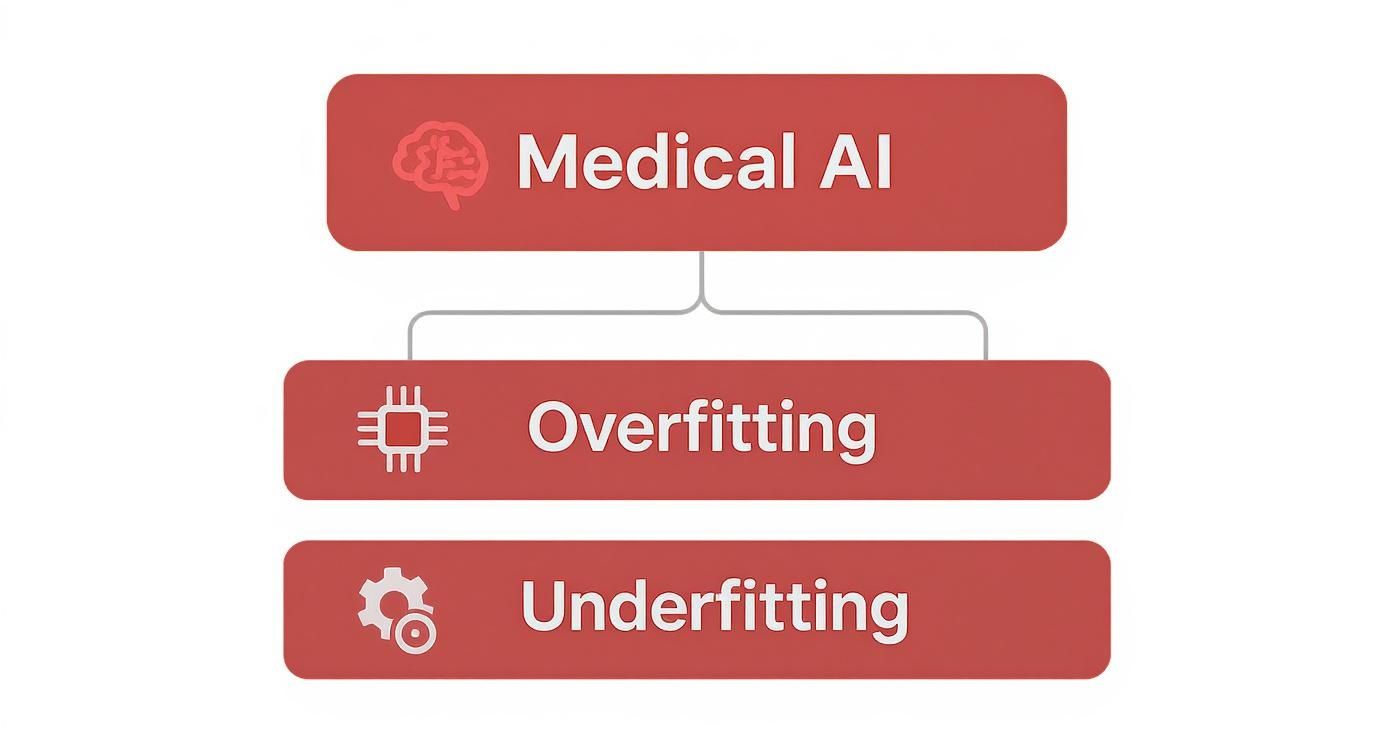
As you can see, both extremes lead to the same outcome: a model that can't deliver reliable results when it matters most.
The Classic Hold-Out Method
The most direct and simple approach is what we call Hold-Out Validation. Imagine you’re studying for a big exam with 100 flashcards. You’d probably set aside 20 cards you’ve never seen before to give yourself a realistic practice test, and use the other 80 for studying.
That’s the hold-out method in a nutshell. You simply split your dataset into two parts: a larger "training set" for the model to learn from and a smaller "testing set" to evaluate it on. It's fast, straightforward, and a great first step, especially when you're working with massive datasets.
But it has a catch. The model's final performance score can be a bit of a lottery, depending heavily on which specific data points happened to land in that test set. A particularly easy or hard split could give you a misleading sense of confidence or failure.
K-Fold Cross-Validation for Robustness
To get a more reliable picture, we turn to K-Fold Cross-Validation. Let’s go back to our chef. Instead of one round of feedback, they now have five groups of taste-testers. They serve the dish five separate times, and each time, a different group gives the official critique. By the end, everyone has had a chance to be the critic, and the chef gets a much more well-rounded and trustworthy verdict.
This is exactly how K-Fold works. We split the data into 'K' equal segments, or "folds." The model is then trained K separate times. In each round, one fold is held out as the test set, while the other K-1 folds are used for training.
Your final performance metric is simply the average across all K rounds. This process is brilliant because it ensures every single data point gets used for both training and validation, giving you a far more stable and honest assessment of how your model will perform in the wild.
By testing the model against multiple, independent subsets of data, K-Fold Cross-Validation builds a more complete and reliable picture of how the model will perform on unseen data.
This meticulous approach is essential for the kind of work we do. At PYCAD, we develop custom web DICOM viewers and integrate them into medical imaging web platforms, where model reliability is everything. You can see how this commitment to rock-solid validation plays out in our real-world medical applications by exploring our portfolio.
Comparison of Common Model Validation Techniques
To make things clearer, let’s compare these methods side-by-side. Each has its place, and knowing when to use which is a hallmark of an experienced team.
| Technique | How It Works | Best For | Key Advantage | Main Disadvantage |
|---|---|---|---|---|
| Hold-Out Validation | The dataset is split once into two parts: a training set and a testing set (e.g., 80/20 split). | Large datasets where a single split is still representative and computational speed is a priority. | Simplicity and Speed: It's computationally inexpensive and very easy to implement. | High Variance: The performance score can be highly dependent on the random split of the data. |
| K-Fold Cross-Validation | The dataset is split into 'K' folds. The model is trained K times, each time using a different fold as the test set. | Small to medium-sized datasets where you need a more reliable performance estimate and can afford the extra training time. | Robustness: Reduces variance by ensuring every data point is used for testing, leading to a more stable evaluation. | Computationally Expensive: Training the model K times can be time-consuming, especially for large K or complex models. |
Ultimately, these techniques aren't just academic exercises. They are the practical, hands-on processes that separate a promising prototype from a medical-grade AI tool that clinicians can actually trust.
How to Measure AI Model Performance Accurately
https://www.youtube.com/embed/8d3JbbSj-I8
So, you’ve picked a validation technique. Now for the big question: how do you actually score the model? Simply looking at a single "accuracy" percentage is a rookie mistake. The real story of a model's worth is found in more specific, nuanced metrics that tell you what's happening under the hood.
Choosing the right metric isn’t a purely technical exercise. It’s about matching your measurement to the real-world clinical goal you’re trying to achieve.
Think of it like a search and rescue team sent into a vast wilderness to find a group of lost hikers. This simple scenario is a fantastic way to understand two of the most vital metrics in machine learning: Precision and Recall.
Finding What Matters Most: Precision vs. Recall
Recall measures the team's ability to find every single lost hiker. If there are ten hikers out there and the team finds all ten, their recall is a perfect 100%. This holds true even if they accidentally "rescued" a few tourists who weren't lost at all.
In a medical setting, high recall is absolutely critical when missing a positive case could be catastrophic—like failing to spot a cancerous tumor. You have to minimize those "false negatives" no matter what.
Precision, on the other hand, is all about the team's ability to ensure that every person they bring back is actually a lost hiker. If they bring back eight people and all eight were genuinely part of the lost group, their precision is 100%.
This is crucial when a false alarm carries a heavy cost, like misdiagnosing a healthy person with a severe illness. That kind of mistake—a "false positive"—can lead to incredible stress, unnecessary costs, and even risky procedures.
Most of the time, you need a smart balance between the two. That’s where the F1-Score comes into play. It’s a single, combined score that harmonizes both precision and recall, giving you a much better sense of the model's overall robustness.
Seeing the Bigger Picture with the AUC-ROC Curve
Another incredibly powerful tool is the AUC-ROC curve. Put simply, this visualizes how well a model can tell the difference between two groups—say, healthy cells versus cancerous ones—across every possible decision point.
A score close to 1.0 indicates an excellent classifier, one that can reliably tell the two apart. A score of 0.5, however, suggests the model is no better than flipping a coin.
Choosing the right performance metric isn't just a technical decision; it's a strategic one that defines what "success" truly means for your specific medical application.
This kind of detailed performance measurement is essential everywhere, not just in medicine. A 2018 review by the European Central Bank, for example, found that weak model validation was the most common and severe problem they discovered during risk management inspections.
As AI becomes more integrated into our tools, understanding its reliability is key. For example, a whole field of study has emerged around the accuracy of AI detectors.
If you’re looking to go deeper on this, our complete guide on how machine learning model evaluation works is a great next step. At PYCAD, we live and breathe these metrics when we build custom web DICOM viewers and integrate them into medical imaging web platforms. It’s how we make sure our solutions meet the incredibly high stakes of clinical practice.
A Real-World Look at Validation in Medical Devices
Theory is great, but seeing model validation in action is where you grasp its true power. Let’s walk through the story of an AI model built to spot hairline fractures in X-rays—a task where precision and reliability are everything. This isn't just a story about code; it's about the painstaking journey to build a tool that clinicians can trust with patient lives.
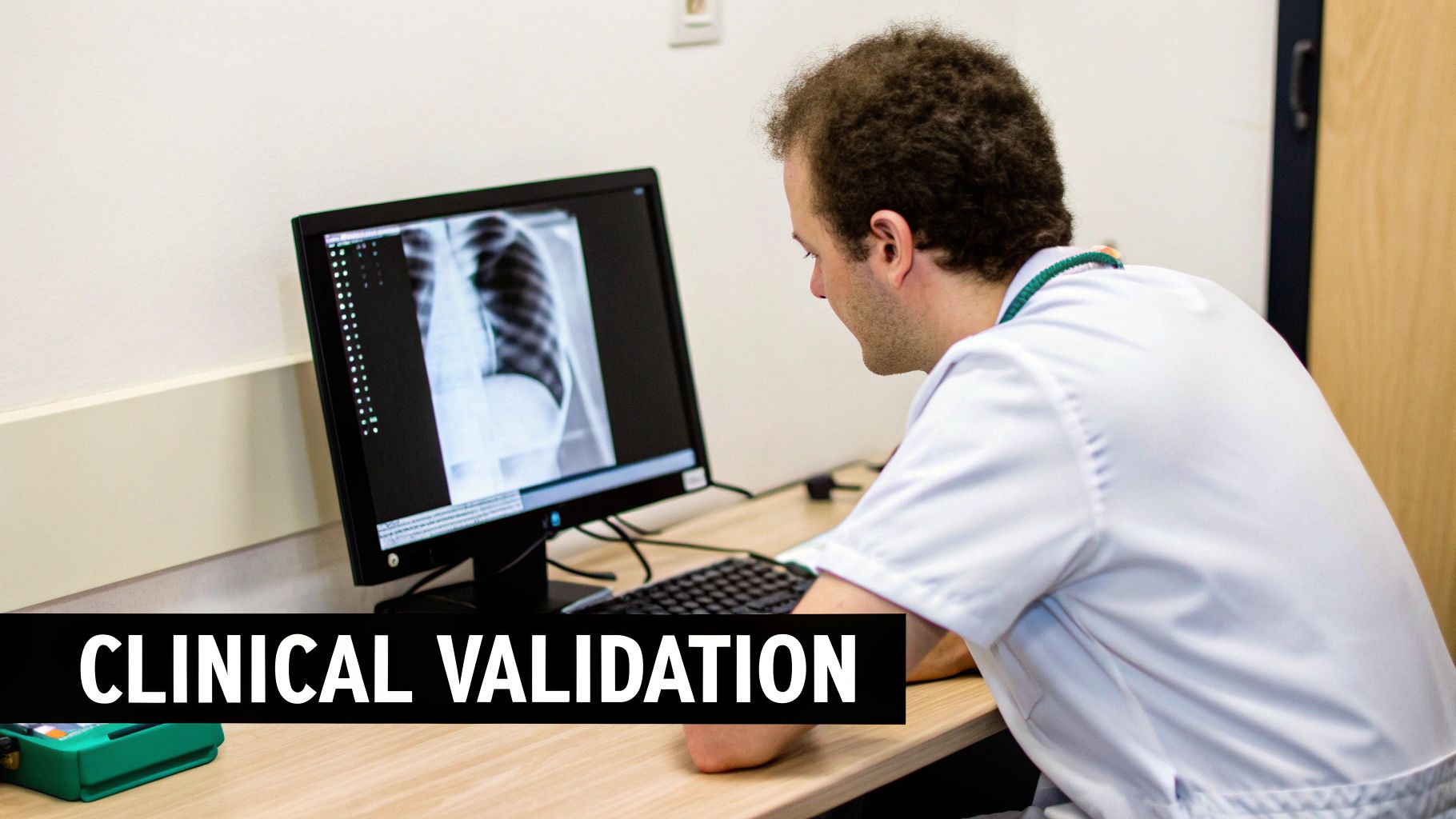
It all started with gathering a rich, diverse dataset—thousands of anonymized X-rays from several different hospitals. The team knew from experience that sourcing images from a single facility would be a recipe for disaster. It would risk overfitting, creating a model that’s brilliant with one type of machine or patient group but fails everywhere else. They carefully partitioned this data, setting aside a large chunk as a pristine, untouched validation set.
From the Training Grounds to the Real World
With the data sorted, the model began its training on the remaining images. After weeks of intense learning, it started posting impressive results on its training data. But that was just the first checkpoint. The real test—the moment of truth—came when they finally let it loose on the validation set. This data was completely new to the model, featuring images from different machines, a wide range of patient ages, and even lower-quality scans to simulate tough, real-world conditions.
This intense testing immediately surfaced a critical weakness. The model was stumbling on X-rays produced by one specific, older machine. Had they skipped this validation step, the model could have been rolled out into clinics, where it would have systematically failed an entire group of patients. This is exactly why a deep understanding of medical device verification and validation isn’t just a nice-to-have; it's about catching and preventing failure before it can ever cause harm.
Excellent validation isn't about proving a model is perfect. It's about rigorously discovering its limitations so they can be addressed before the model ever impacts a single patient's life.
This entire process points to a significant shift happening in the industry. We're moving away from one-and-done testing toward more dynamic, living frameworks. To keep up, emerging research points to integrating real-time data feeds and continuous model updates to ensure accuracy doesn't degrade over time.
At PYCAD, we live and breathe this level of meticulous validation. In every project, we build custom web DICOM viewers and integrate them into medical imaging web platforms, knowing our work has to hold up under the immense pressures of real-world clinical use. You can see examples of our work in our portfolio.
Building the Future of Trustworthy Medical AI
When you get down to it, model validation in healthcare is so much more than a technical box to check. It's a fundamental promise we make to patients. With a person's health on the line, we have a moral obligation to ensure our AI models are not just accurate but also dependable and fair. This isn't just good science; it's the bedrock of trust between technology, clinicians, and the people they serve.
This deep commitment to rigorous validation is what will truly shape the next wave of medical breakthroughs.
To get there, we all need a solid and evolving understanding healthcare artificial intelligence. The field is already pushing beyond one-and-done validation. We're moving toward concepts like continuous monitoring and real-world performance tracking, where models are constantly learning and adapting to maintain their integrity long after they've been deployed.
Championing these high standards is a team sport. It takes developers, clinicians, and healthcare leaders all pulling in the same direction, demanding proven excellence from the tools we build and use every day.
This is the work that gets us out of bed in the morning at PYCAD. We love partnering with innovators to bring ambitious medical AI projects to life—safely and responsibly. Our specialty is helping you build custom web DICOM viewers and integrate them into medical imaging web platforms, turning brilliant ideas into clinical solutions that doctors and patients can count on.
If you’re ready to build the future of medical AI with a team that puts validation and patient safety first, take a look at our portfolio. Let’s start the conversation.
Got Questions About Model Validation? We've Got Answers.
Jumping into the world of AI always sparks a lot of questions. Model validation might seem straightforward, but its nuances can trip up even experienced teams. Let's clear the air and tackle some of the most common questions we hear, so you can move forward with confidence.
What’s the Difference Between Model Validation and Model Testing?
Imagine a chef developing a new recipe for their restaurant.
Model validation is like the work done inside the kitchen. The chef experiments with ingredients, adjusts the cooking time, and has the kitchen staff taste-test different versions. It's an internal feedback loop, all part of the development process to perfect the dish before it's ever served.
Model testing, on the other hand, is opening night. The final, perfected dish goes on the menu and is served to actual customers. Their feedback is the ultimate test—an unbiased judgment on data the model has never encountered before. This is the final exam, the real-world performance grade.
Why Is It a Terrible Idea to Use Only Training Data for Validation?
Relying on your training data for validation is like letting a student grade their own exam with the answer key in hand. Sure, they might get a 100%, but does that mean they actually learned the material? Or did they just memorize the answers?
A model can do the exact same thing by "memorizing" the training data. This is a classic problem called overfitting, and it leads to a performance score that looks fantastic on paper but is completely misleading. The moment that model sees brand-new data, it will almost certainly stumble, because it never learned the real patterns—it just memorized the test.
How Does Model Validation Connect to Regulatory Approval?
For AI-powered medical devices, model validation isn't just a best practice; it's the bedrock of regulatory approval. Agencies like the FDA demand irrefutable, documented proof that a device is safe and effective for the people it's meant to help.
Where does that proof come from? A meticulous, well-documented validation strategy. You have to prove, without a doubt, that your model performs reliably on diverse, independent data that mirrors the real world. Think of your validation results as the core evidence in your submission—it's a non-negotiable piece of the puzzle that demonstrates your model can be trusted.
You can see examples of our real-world, validated work in our portfolio.
Here at PYCAD, we believe that rigorous validation is the heart of trustworthy medical AI. We specialize in helping innovators build custom web DICOM viewers and integrate them into medical imaging web platforms, ensuring every solution is built on a foundation of proven reliability and safety.