
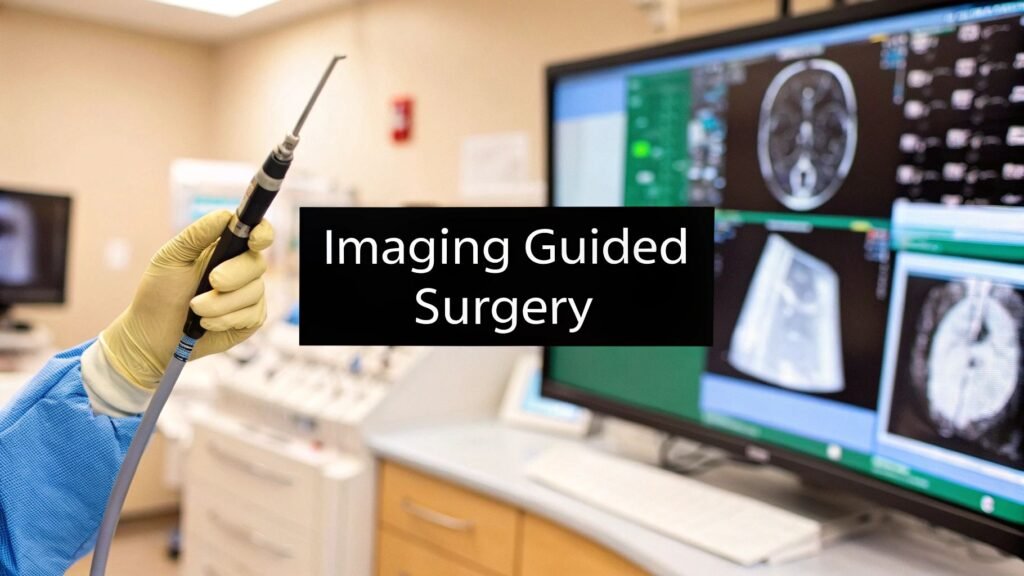
Imaging guided surgery (IGS) is a navigation loop in the OR: a pre-operative (or intra-operative) volume is the map, a tracker watches the instruments, and a workstation draws the tool on that map in real time. It is not a robotic arm. It is not a PYCAD surgical-planning product, and it is not a substitute for a surgeon.
If you meant the coordinate frame the map is drawn in → image coordinate system. If you meant what a cross-section is → cross-section analysis. If you meant the hospital imaging stack (PACS / viewer) → medical imaging software. If you meant a 3D model printed for rehearsal → that is a 665 job, not this page.
PYCAD builds custom web DICOM viewers and imaging models. A planning volume can open in a clinic app. That is not an OR tracker, and it is not a surgical-planning SKU.
What actually has to be in the room
The GPS analogy is fair if you keep the failure modes: a bad map, a lagging satellite, or a car that is not the one you registered. IGS is the same four pieces.
| Piece | Job | Typical hardware |
|---|---|---|
| The map | A 3D patient model, usually from CT or MRI, sometimes updated with a 3D C-arm or ultrasound in the room | Pre-op CT/MR. Intra-op cone-beam / 3D C-arm. Ultrasound |
| The tracker | Where the patient and the tools are, in the same room frame, right now | Optical (infrared cameras + reflective markers) or electromagnetic (a field generator + coils in the tool) |
| The workstation | Registers map to patient, draws the tool, warns when you leave the plan | A computer next to the table, not a PACS station down the hall |
| Tracked instruments | The pointer, drill, or probe the tracker can see | Tools with clip-on spheres or built-in EM sensors. Calibration is a step, not a slogan |
Registration is the unglamorous core: you pick points (or a surface) on the patient that correspond to points on the scan, and the software computes a rigid (sometimes deformable) transform. If that transform is wrong, every millimetre of “guidance” is a confident error. Optical trackers hate a blocked camera. EM trackers hate metal. Neither is magic.
How the map is made
X-ray in 1895 gave a shadow. CT and MRI gave a volume you could plan on. IGS is the step that puts that volume and the physical patient into one coordinate frame while you operate. The cameras themselves are not the news:
- CT owns bone, screw trajectories, facial and pelvic trauma, skull entry. Fast. Ionizing.
- MRI owns brain, cord, and the soft-tissue edge of a tumour. Slow. No ionizing radiation. The magnet is a room, not a C-arm.
- Fluoroscopy is live X-ray video — vessels, fracture reduction, a wire you can watch move. Dose adds up.
- Ultrasound is live, portable, no radiation. Soft tissue and fluid. Operator-dependent. A useful intra-op update, not a planning CT.
Window/level on the planning CT is 686, not this page. The gantry as a machine is CT scan reader.
Where it is actually used
The useful version names a specialty and a failure you are trying not to make.
Neurosurgery
A pre-op MRI (sometimes with fMRI or DTI) is the map. Tracked instruments show how close the tip is to a tumour edge and to cortex you meant to spare. The limit is brain shift: once you open the dura, the map is yesterday’s anatomy. Intra-op MRI or ultrasound exists to refresh it. IGS does not remove the tumour; it keeps the tool on the plan until the plan is stale.
Orthopedics
A CT-based plan for a hip or knee sets implant size and angles. Trackers on the pelvis and the tools give live version of that plan — inclination, version, a cut you can still undo. Alignment is millimetres and degrees because a few degrees of cup version is a dislocation risk, not a cosmetic. This is not “the robot did the case.” The robot, if present, is the hands. IGS is the map.
ENT / sinus
A sinus CT is a maze next to orbit and skull base. A tracked pointer on that CT is how you know the tip is still in the intended cell and not in the orbit. Tight spaces, thin bone, a map that does not deform much — this is a good IGS problem.
IGS is not the robot
People mash the two nouns. Keep them apart:
- IGS is navigation: map + tracker + display. Information.
- Robotic surgery is execution: mechanical arms the surgeon drives. Motion.
They combine often. They are not the same purchase. Augmented-reality overlays (the map drawn on the field through a headset) are the same registration problem with a different screen. Registration error is still the failure mode.
What this page is not
- Not a services page.
/services/surgical-planning-software/is a later leftover; it is not rewritten here, and this blog URL does not 301 into it. - Not a market forecast. Roots Analysis / Market.us CAGRs, an invented “safer / smaller / home sooner” patient FAQ, ekipa.ai, and Outrank stills are gone.
- Not a PYCAD OR platform, tracker, or implant-planning SKU.
If the missing piece is a web viewer that can hang the planning CT/MR a team already has, that is the imaging piece. Case studies.